
“Winning big matters less than staying in the game.”
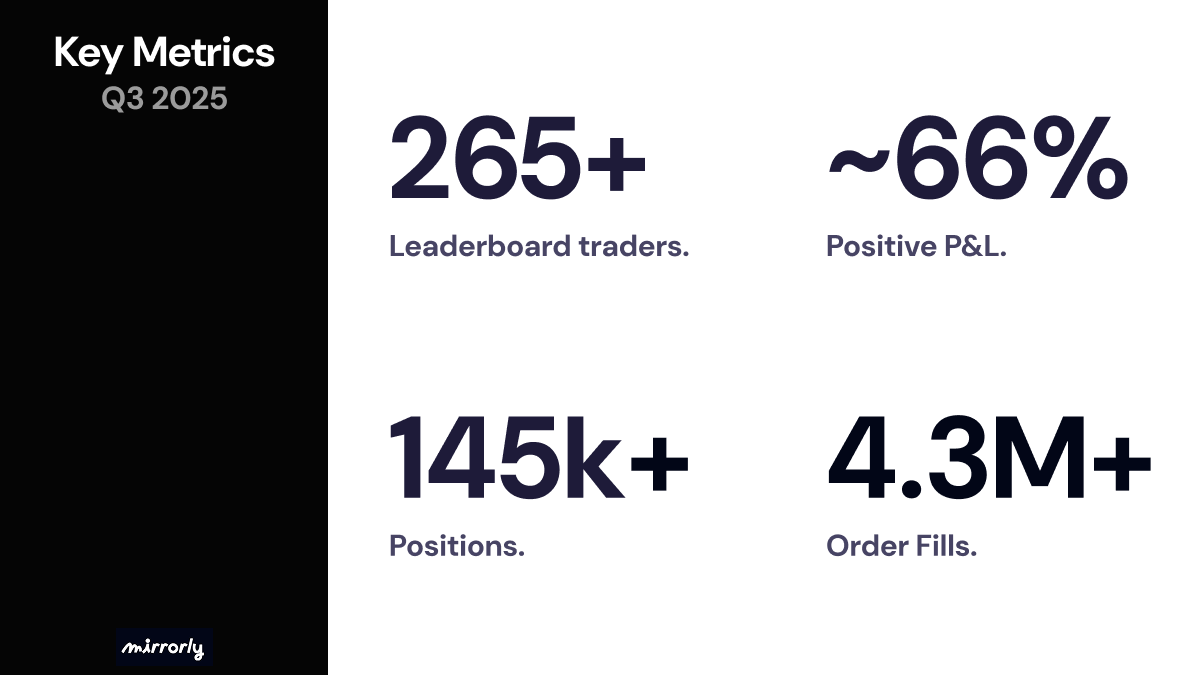
In Q3 2025, the number of traders on Mirrorly’s curated list grew from 210 to over 265. During this period, 66% of them generated profits, 5% more than the previous Quarter. We tracked more than 145k positions and over 4.3 million order fills.
Market Overview#
Q2 was a strong quarter for crypto markets, with major assets posting double-digit gains. Q3 began on a similar note ($SOL led the rally, up nearly 30% by late July) but volatility soon returned. By early August, $BTC, $ETH, and $SOL had fallen between -20% and -40%. The remainder of the quarter was marked by choppy price action, with $BTC and $SOL ending roughly flat and $ETH closing Q3 down 24%.
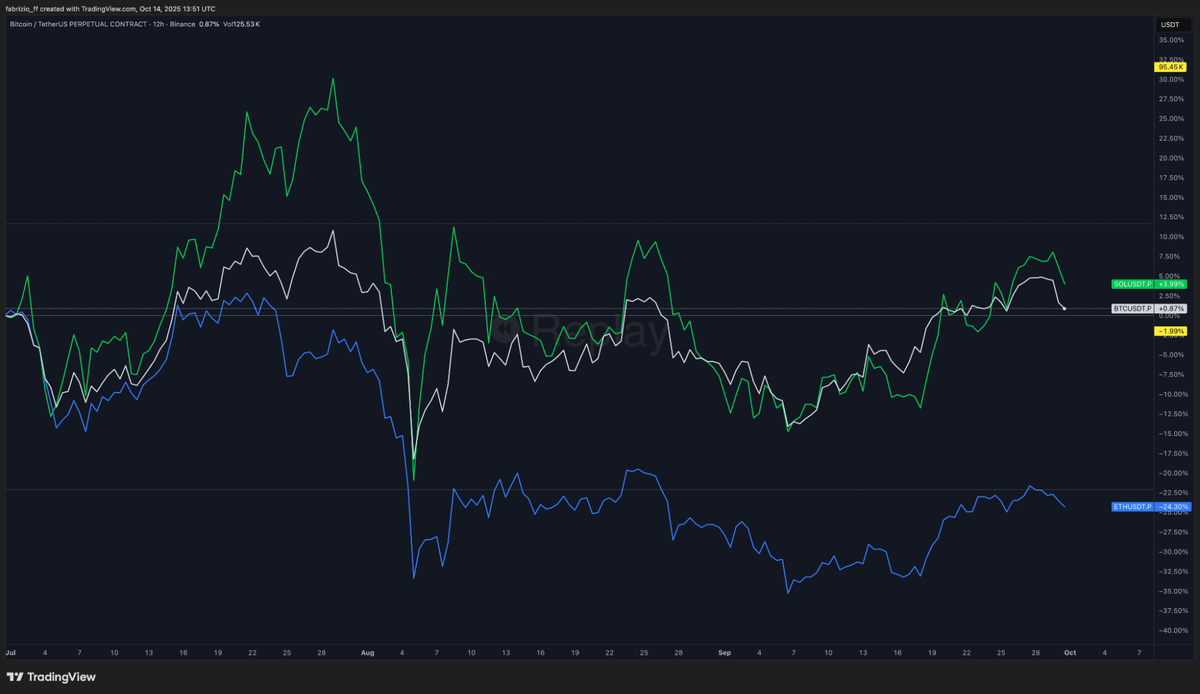
Despite the tougher market conditions, the share of profitable traders rose from 61% in Q2 to 66% in Q3.
Top 10 Traders Overview#
The top ten Mirrorly traders of Q3 recorded profits ranging from $4.1 million to $35.3 million, with a median of $10.8 million.
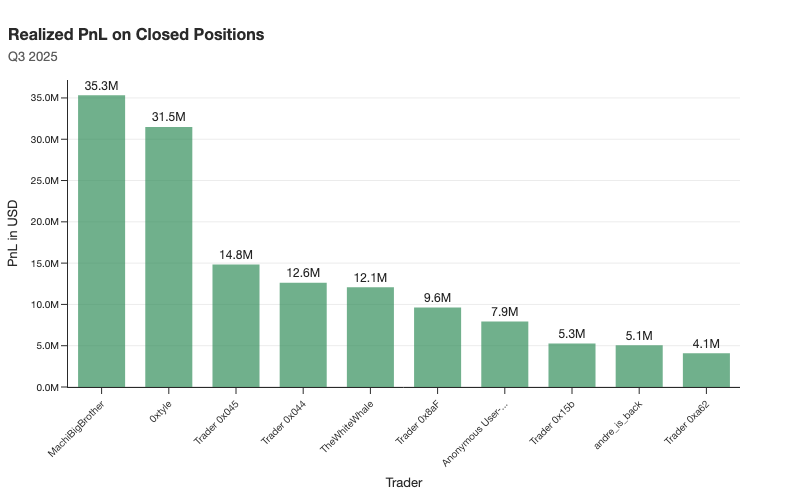
Dominating the quarter were MachiBigBrother and 0xtyle, both exceeding $30 million in realized PnL. MachiBigBrother earned $35 million from 86 positions with an 86% win rate and a profit factor of 2.58, while 0xtyle posted $31.5 million from 90 positions with a lower 63.3% win rate but a much higher profit factor of 10.8. In third place, Trader 0x045 made $14.8 million across 10 positions with a significant profit factor of 19.6. Among traders with at least ten closed positions, profit factors ranged between 1.95 and 539, the latter belonging to TheWhiteWhale, whose 49 closed positions had an average win/loss ratio of 26.9x.

However, this report follows the October 10th market crash, the largest liquidation event in crypto history, which erased a significant portion of the gains many top traders had built up. The majority of them had achieved their results through aggressive, highly leveraged portfolios, and the event exposed that vulnerability. Still, some traders managed to profit from the turmoil, for instance, Trader 0x8aF, who earned nearly $16 million during the crash week.
This divergence highlights the importance of understanding each trader’s market bias and risk profile. Some excel in bullish environments, others in volatile or bearish conditions. For copytraders, recognizing these distinctions and diversifying across traders with complementary characteristics is essential to reduce portfolio volatility and avoid large drawdowns.
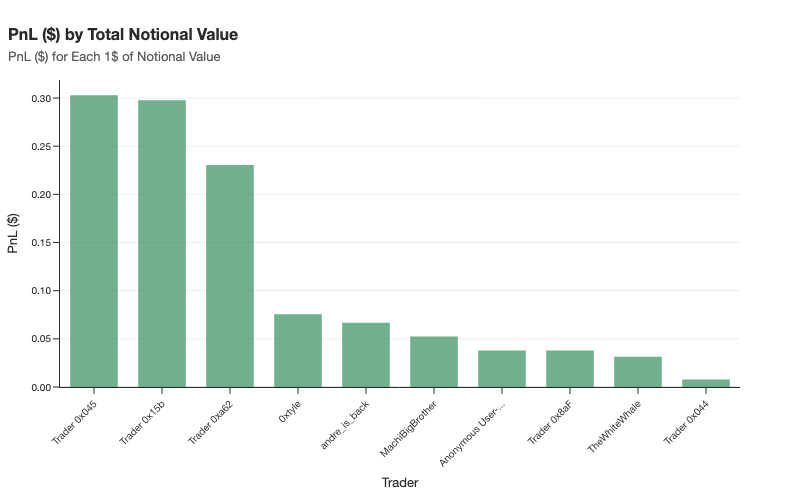
When measured by profit per unit of exposure, the most efficient traders were 0x045, 0x15b, and 0xa62, earning between $0.23 and $0.30 per $1 of notional exposure. By comparison, MachiBigBrother and 0xtyle, despite their large absolute profits, generated $0.075 and $0.05 per $1, respectively. The lowest in the group, 0x044, earned roughly $0.02 per $1.
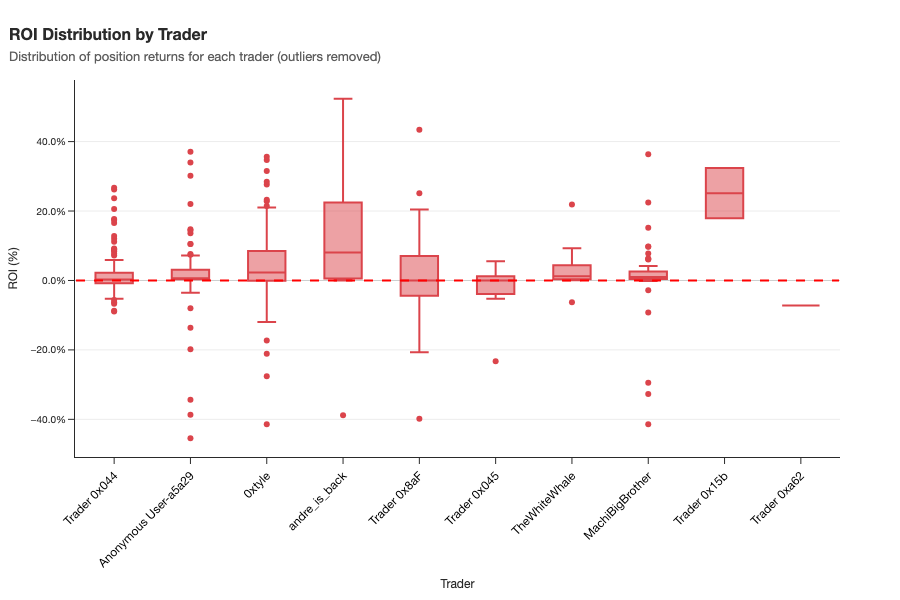
The ROI distribution further reveals that most traders averaged around breakeven, with 0x044 showing the most positively skewed profile, limiting losses to about -15% while capturing gains above +30%. Conversely, User-a5a029, 0xtyle, and MachiBigBrother displayed more symmetrical profiles, with wins and losses generally contained within the -40% to +40% range.
When Aggression Pays Off – and Backfires#
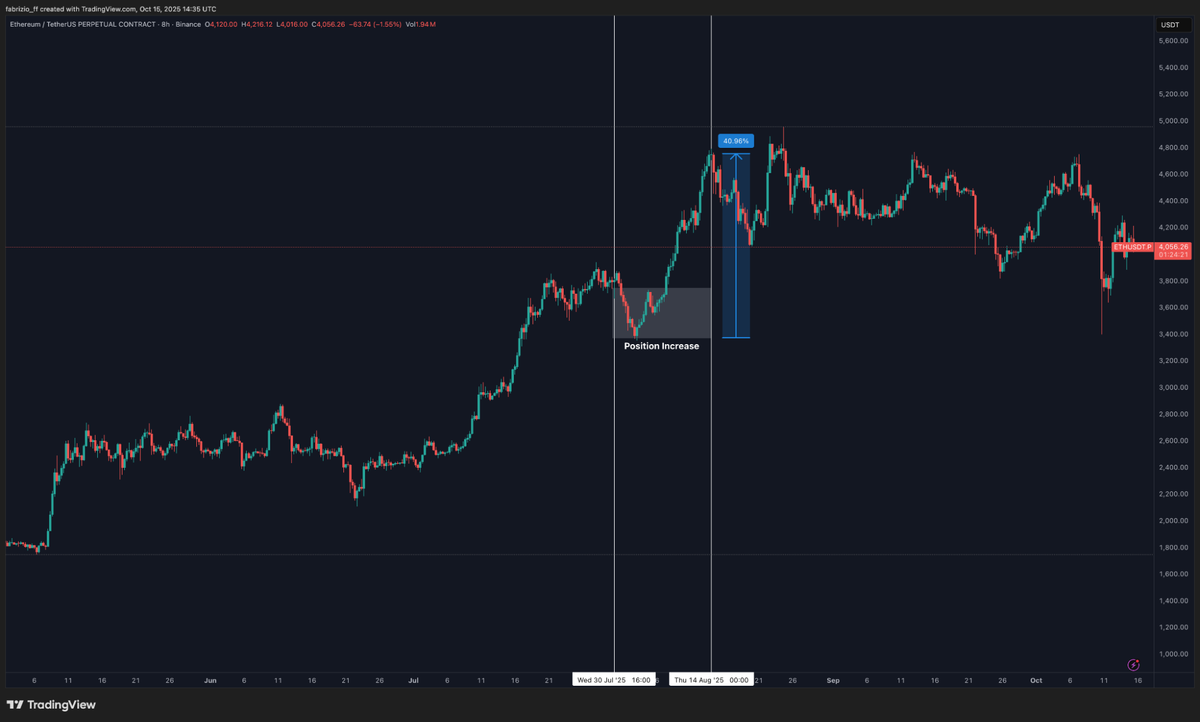
The most profitable single position among all traders covered in this report was an $ETH long by MachiBigBrother, which yielded nearly $40 million in profit over two weeks, a 36% ROI.
As noted earlier, such returns required a highly aggressive approach. When he opened the position on July 31, MachiBigBrother’s balance was $32.8 million. He likely initiated the trade anticipating an $ETH breakout above the $3,900 level, but prices quickly dropped over 3% by August 3. Instead of exiting, he scaled up aggressively, with his position size peaking above $100 million in notional, implying over 3x portfolio exposure. The move paid off: $ETH reversed sharply, rallying more than 40% from the August 3 low, and MachiBigBrother closed the trade by August 13, near the local top. This single position accounted for nearly all of his $35 million Q3 profits.
However, high leverage cuts both ways. As mentioned earlier, during the October 10 market crash, MachiBigBrother lost the entire profit built since May, a reminder of the risks tied to aggressive strategies.
For copytraders, this highlights one of Mirrorly’s key advantages: you can gain exposure to top-performing traders without mirroring their full risk profile. Allocating only a portion of capital to high-volatility traders like MachiBigBrother, while diversifying across steadier performers, allows users to maintain asymmetric upside with controlled downside.
A contrasting example is HummusXBT, who manages a long/short portfolio with moderate leverage. Currently midway through his $2M to $10M challenge, he stands at $6.6M (a $4.6M gain). Reflecting on his journey, he noted:
“As you all would have noticed, I have underperformed for many months while people were posting 7-8 figure PnLs left and right — this was not easy.”
His approach highlights a different kind of skill. One grounded in discipline, lower risk, and long-term consistency, even if it means progressing more slowly.
Conclusion#
Q3 closed before the October 10 liquidation event, marking the end of a quarter that balanced strong performance with growing volatility. Many top traders achieved exceptional results through aggressive positioning, but the subsequent market crash showed how fragile those gains could be. For users, the key is to look beyond PnL and understand each trader’s approach and risk profile, thus using Mirrorly to build a balanced mix of traders that align with their own objectives and tolerance for risk.
Want to track and copy the best traders on Binance and Hyperliquid?
Join Mirrorly to access real-time insights from top leaderboard accounts and follow their moves with precision.
👉 Access Here
Check out the blog for more insights: https://blog.mirrorly.xyz/
Disclaimer#
We track a carefully curated and regularly updated list of top-performing public traders across platforms like Binance and Hyperliquid. While we aim for high data accuracy, some limitations remain, such as traders switching to private mode or technical constraints like rate limits. Despite these challenges, we dedicate significant effort to ensure the data is as reliable as possible.