
In 2025, the total crypto market cap crossed $4 trillion for the first time. Around the same time, large traditional institutions like Fidelity, JPMorgan, and Visa began offering, or preparing to offer, crypto products directly to consumers.
Buying, selling, and holding digital assets is no longer limited to native crypto platforms. It now happens alongside equities, ETFs, and other traditional instruments, marking a clear shift in how crypto fits into the broader financial system.
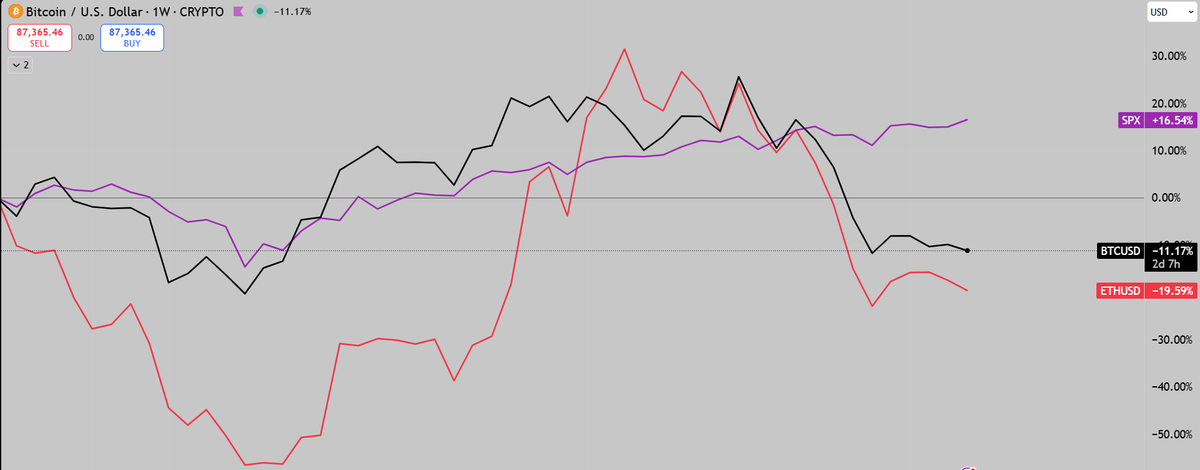
All that said, 2025 wasn’t a straight line higher. It was a year shaped by clear regime shifts, sharp rotations, and long stretches where patience mattered more than prediction. Bitcoin led at times, lagged at others, and often moved out of sync from traditional assets. Equities told a different story, with the S&P 500 following its own rhythm for most of the year, until markets (especially crypto) finally snapped on October 10.
Mirrorly by the Numbers#
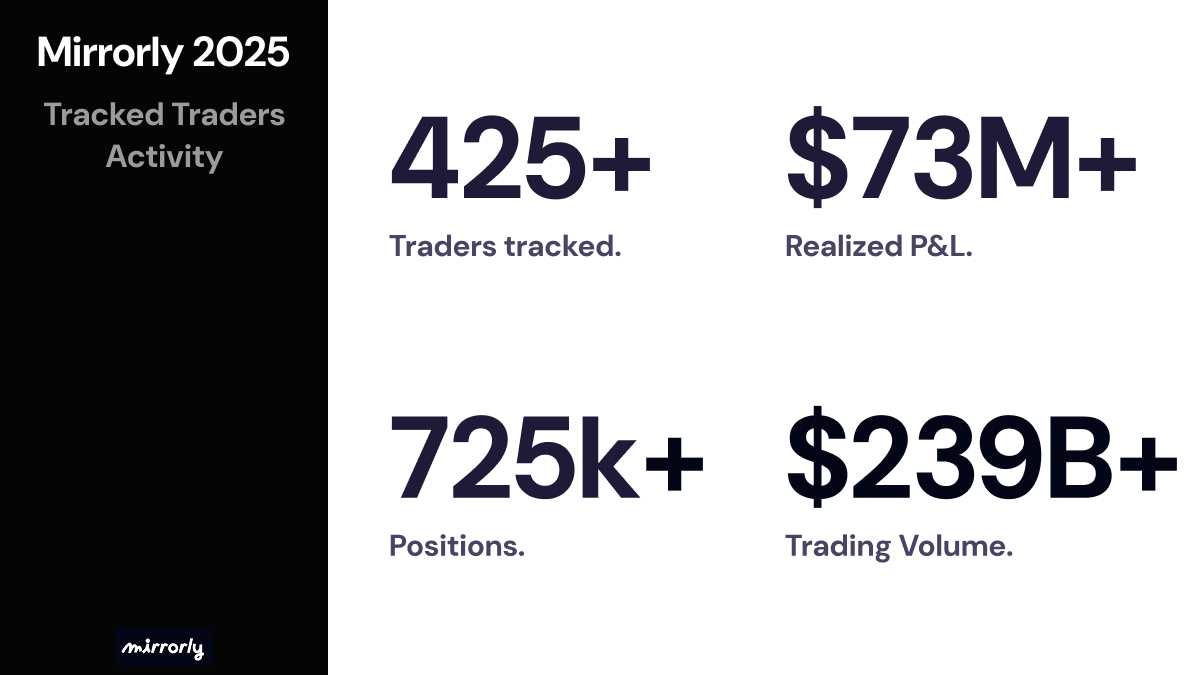
Despite the shifting regimes and volatile conditions that defined 2025, Mirrorly’s curated trader universe remained highly active. Across more than 425 tracked traders, the platform recorded over 725k closed positions, more than $239 billion in trading volume, and $73 million in aggregated realized P&L, providing a direct view into how top traders navigated a year defined by fast rotations and uneven market conditions.
How Profits are Distributed Among Traders#
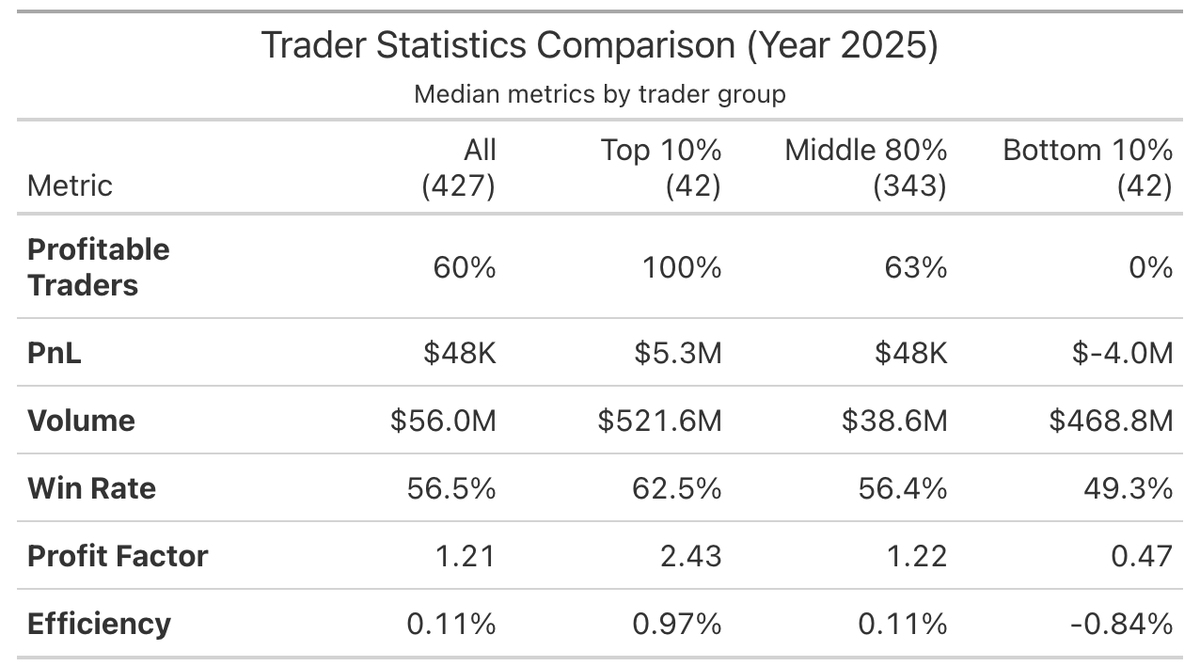
Scale alone is not enough, what matters is whether that activity reflects a real, repeatable edge. The table below summarizes performance across all traders tracked by Mirrorly during 2025, including both active and archived ones, segmented by profitability.
Despite a difficult market year, the median trader across the entire universe was profitable, with 60% of all traders finishing in the green and a median PnL of $48k. Even within the middle 80% of traders, median PnL remained $48k with a 56% win rate, indicating that profitability was not confined to a small elite. Losses were concentrated almost entirely in the bottom 10%, which recorded a –$4.0M median PnL and a 0.47 profit factor, while the top 10% generated a median $5.3M in PnL with a 2.43 profit factor. This distribution highlights the high standard and strong selection quality of Mirrorly’s curated trader universe.
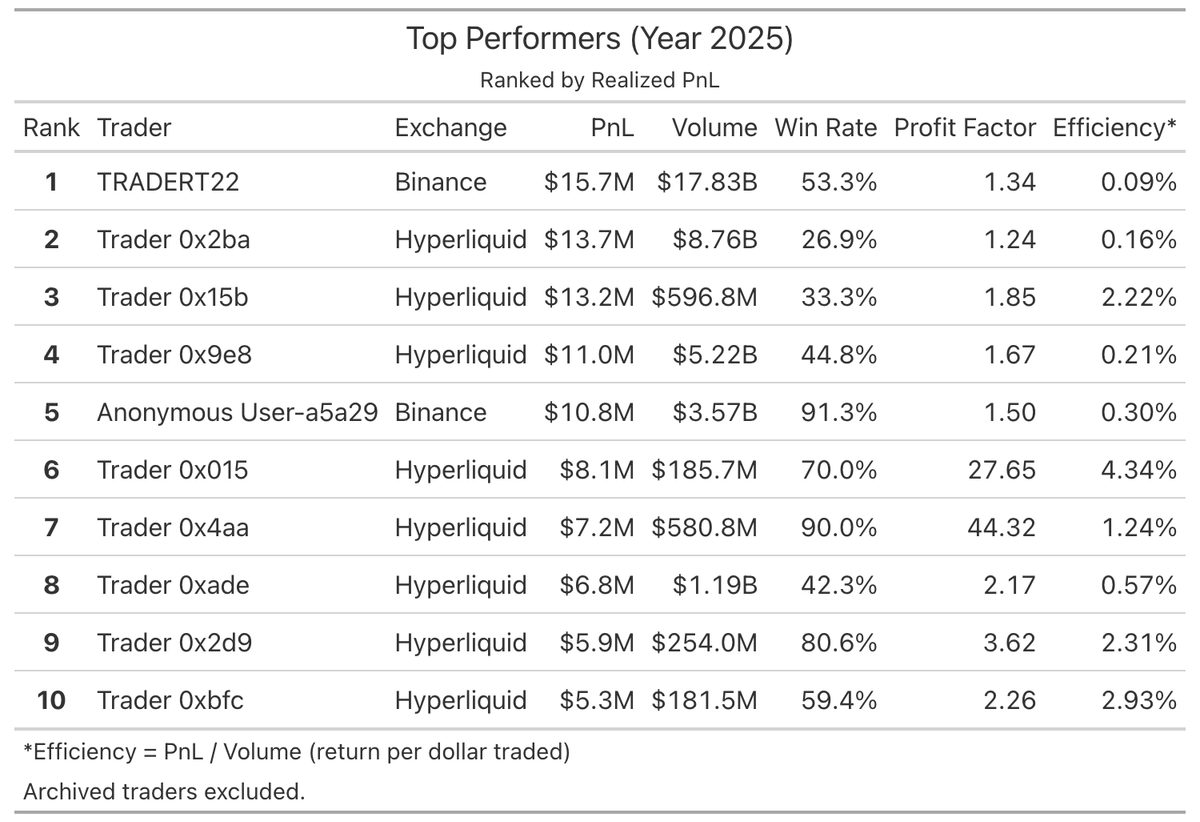
Looking at the top 10 active traders by realized PnL in 2025, performance spans a wide range of trading styles and risk profiles. Realized profits range from $5.3M to $15.7M, with trading volumes stretching from under $200M to more than $17B, and win rates from 27% to over 90%.
Some of the most profitable traders achieved their results through high turnover and thin margins, reflected in low Efficiency (PnL / Volume), while others generated comparable PnL with much lower volume but significantly higher Efficiency, meaning they extracted more profit per dollar traded, showing that there is no single path to top-tier performance.
Following the Money: Narratives and Volume#
The following image tracks the monthly share of perpetuals trading volume by symbol across 2025 for the curated list of traders tracked on Mirrorly, ranking the top ten contracts each month by share of traded notional. While $BTC, $ETH, $SOL, and $HYPE occupy the top four positions almost mechanically, the layers below show far greater turnover, reflecting how trader attention rotated rapidly across narratives throughout the year.
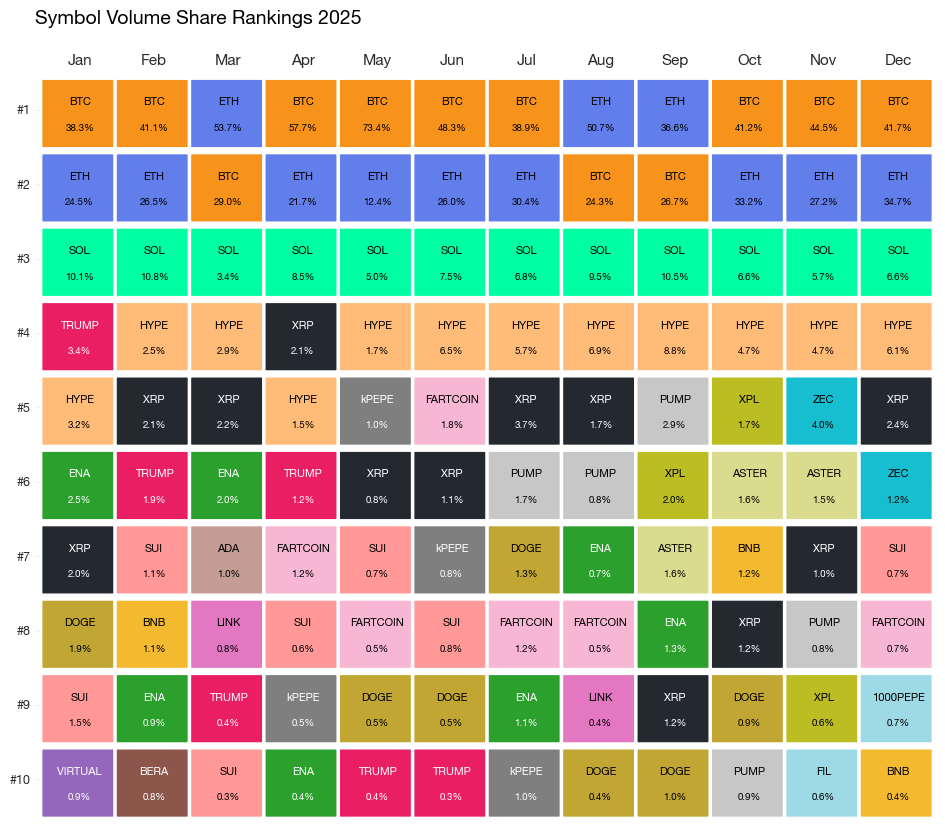
Mirrorly’s non-major trading in 2025 was concentrated in a small set of symbols that rotated with shifting narratives. In January and February, volume was led by $TRUMP, following the launch of Donald Trump’s Solana-based token that briefly reached a multi-billion-dollar market cap, with $ENA and $SUI acting as secondary infrastructure and ecosystem exposure. In March, trading shifted toward DeFi and U.S.-linked “dino coins” as Trump’s tariff announcements triggered market stress and a pivot toward American crypto exposure, bringing $ENA, $ADA, and $LINK to the top.
From April through June, activity moved into memecoins, with $FARTCOIN and $kPEPE dominating volumes alongside $TRUMP and $SUI, reflecting flows driven by meme-liquidity venues rather than fundamental themes. In July and August, $PUMP became the leading non-major as Pump.fun and related meme-trading infrastructure concentrated speculative volume, with $DOGE, $ENA, and $FARTCOIN remaining active.
In September and October, volume rotated into DEX-centric tokens $XPL and $ASTER, alongside $PUMP, reflecting farming and liquidity-mining activity within decentralized trading venues. From November through December, $ZEC became the dominant non-major as privacy-focused assets gained attention, while capital rotated away from $ASTER and $XPL.
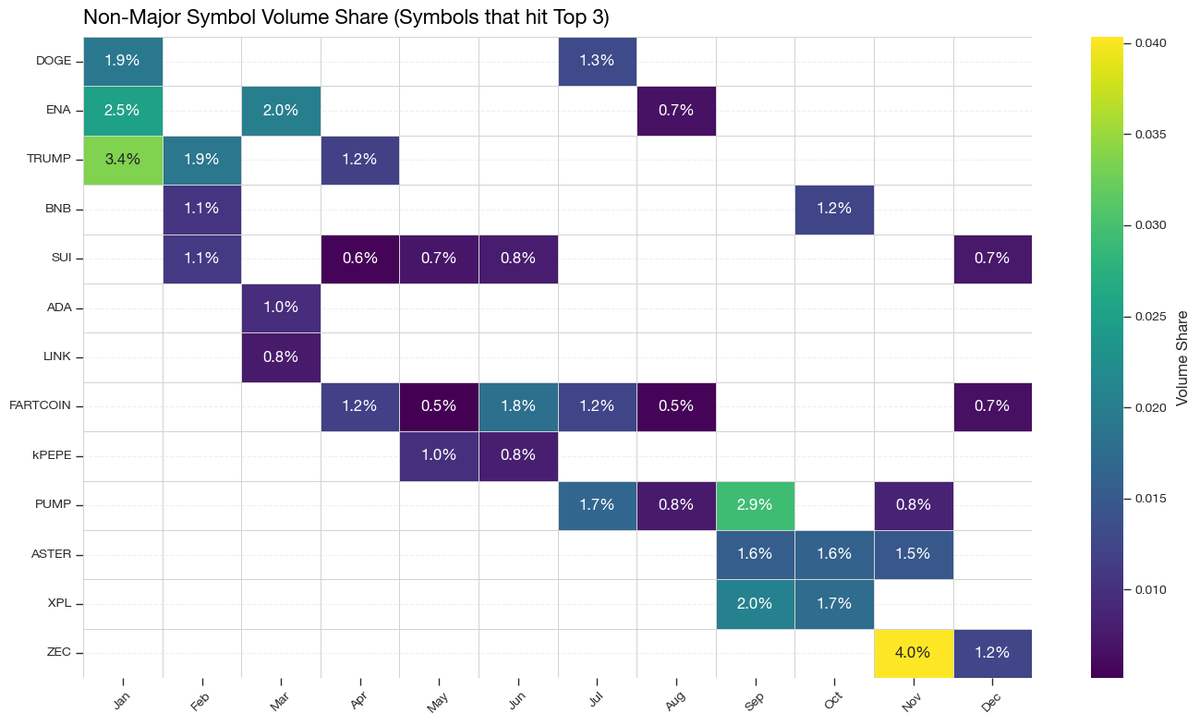
Against this backdrop of rapidly shifting narratives and capital rotations, the aggregate PnL of Mirrorly’s traders on these non-major symbols provides an important reality check on whether those rotations were actually monetized.
As the heatmap shows, across memecoins, ecosystem tokens, and DeFi or DEX-centric assets, Mirrorly’s trader universe generated positive net PnL in most of the months where activity was concentrated, with several narratives delivering outsized gains when volume peaked.
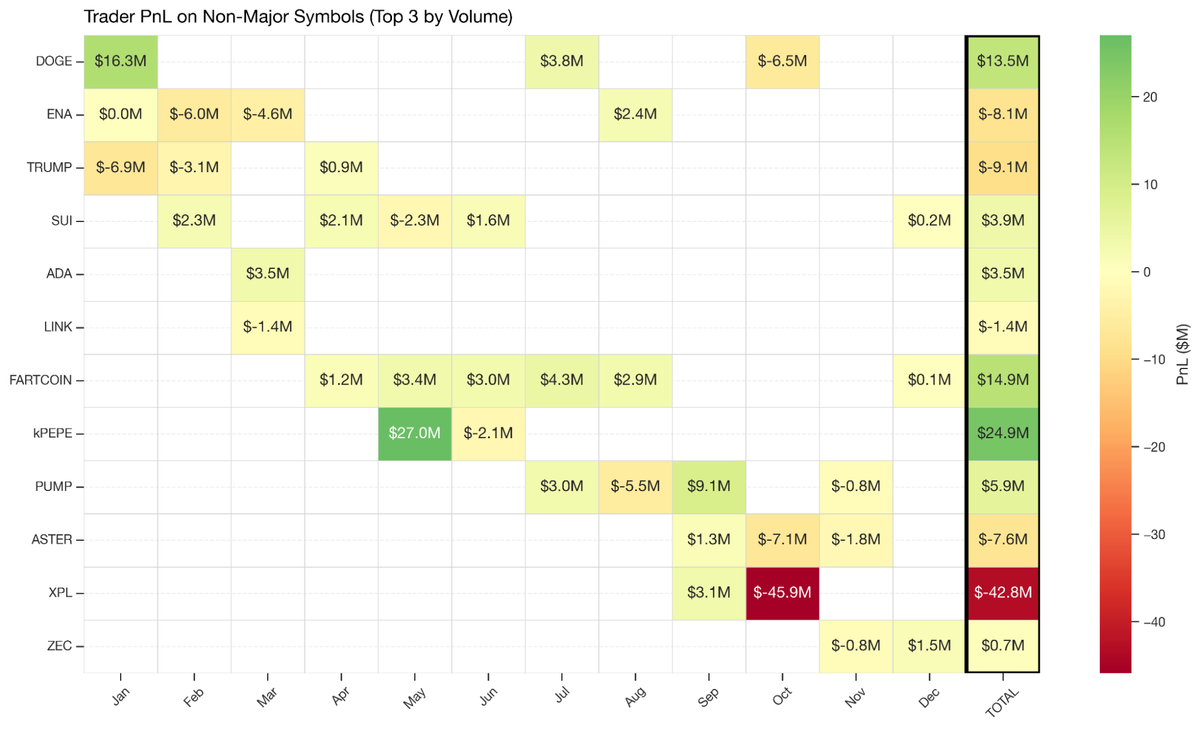
While individual large traders inevitably have a disproportionate impact on aggregate results, the fact that profits were realized across multiple, distinct narratives over the year indicates that Mirrorly traders, in aggregate, were able to position effectively into the dominant themes as they emerged and extract real economic value from them. They actively followed where attention, liquidity, and opportunity moved, shifting exposure as narratives evolved throughout the year. Their activity reflected the live pulse of the crypto market, adapting quickly as new stories took over and old ones faded.
To complete the picture, the same analysis applied to the major markets shows that this ability to extract value was not limited to niche narratives. Across $BTC, $ETH, $SOL, $XRP, and $HYPE, Mirrorly’s traders generated net positive PnL in four out of five symbols over the year, with $BTC and $ETH contributing the largest share of aggregate profits.
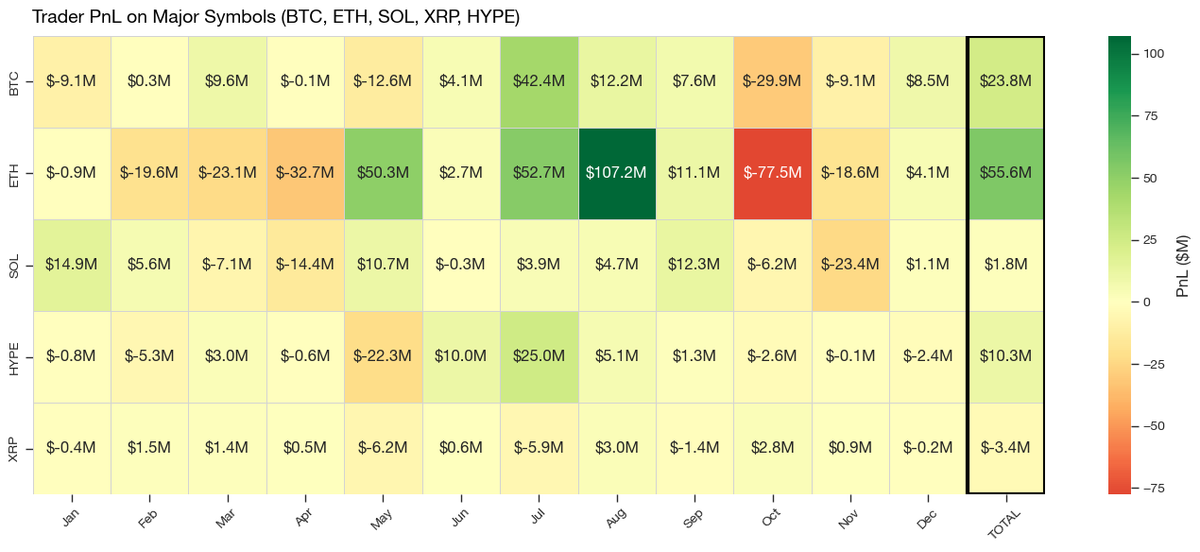
This confirms that Mirrorly’s trader universe was not only effective at rotating into emerging narratives, but also consistently profitable in the core assets that anchor the crypto market.
How Mirrorly Users Performed#
If Mirrorly’s curated trader universe was able to consistently extract profits across narratives and market regimes, the next question is whether that edge actually translates into results for users who copy them. In 2025, the answer was clearly yes. Mirrorly’s users generated $4.92M in aggregated copy-trading PnL over the year, marking the second consecutive profitable year for the platform.
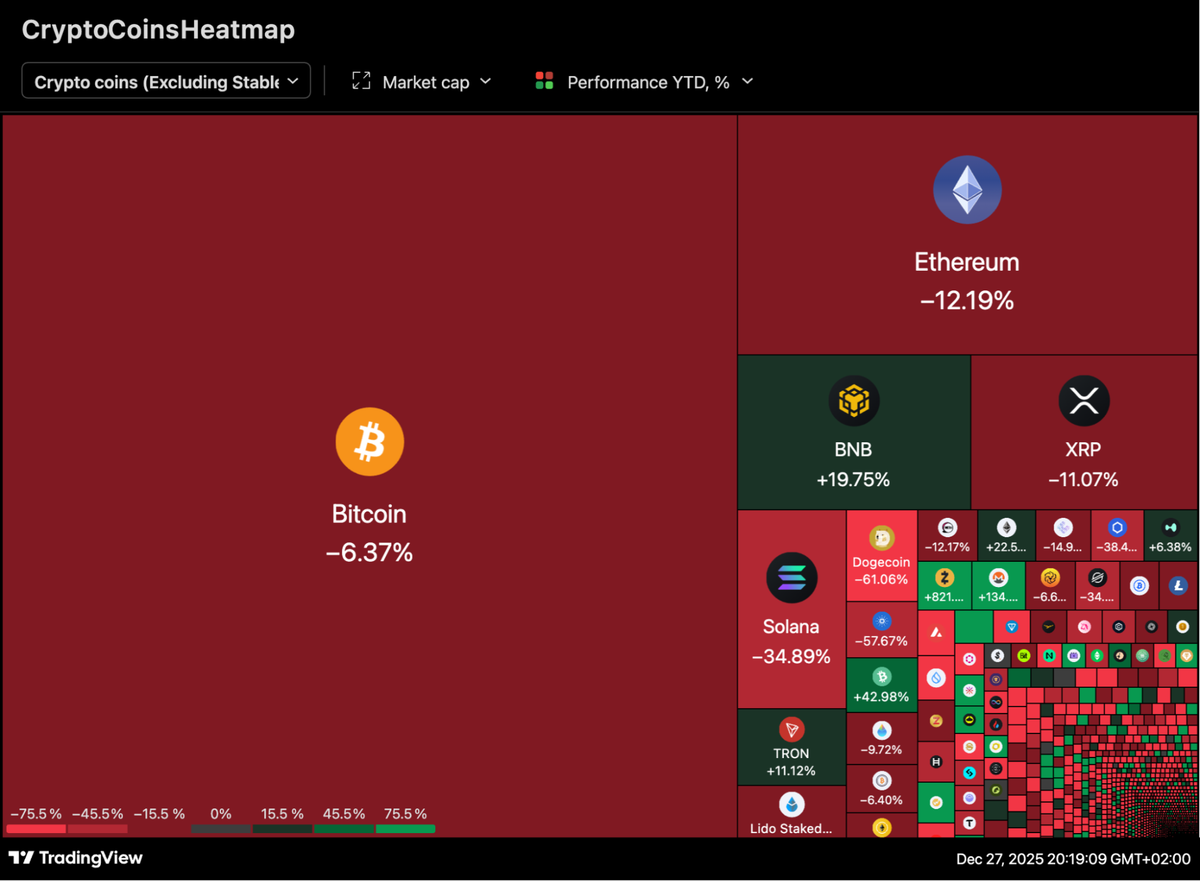
51% of all copytraders finished the year in profit, despite a difficult market backdrop in which Bitcoin is down roughly 10% and most altcoins are in the red year-to-date.
By comparison, only 0.42% of Pump.fun wallets (about 55,000 out of 13.4 million) made at least $10,000 over the year, and only low double-digit percentages of Hyperliquid traders were profitable over the same period.
This performance gap highlights the core value proposition of Mirrorly. In an environment where the vast majority of retail traders lose money and spend significant time actively trading, Mirrorly users gain exposure to a curated universe of professional traders who, on average, generate positive returns. Rather than attempting to compete directly in highly efficient and fast-moving markets, users can allocate capital across multiple proven traders, benefiting from diversification across strategies, assets, and time horizons. In practice, this shifts the burden of research, execution, and risk management from the individual user to a portfolio of traders with a demonstrated ability to extract edge from the market.
Conclusion#
2025 confirmed that crypto markets are driven by rapid narrative shifts and fast capital rotations rather than simple directional trends. Across these conditions, Mirrorly’s curated trader universe consistently demonstrated the ability to adapt and generate real profits, both in emerging narratives and in the core assets that anchor the market.
For users, this edge translated into measurable results. In a year when most retail traders struggled, Mirrorly’s copytraders produced positive aggregate returns and a majority finished in profit, showing that access to a diversified set of proven traders offers a more effective way to participate in crypto markets than trading alone.
Join Mirrorly: https://portal.mirrorly.xyz/
Subscribe to our Notifications so you don't miss next month's report!