
Study after study confirms that the vast majority of retail traders lose money. Estimates range from 80% to 95%, depending on the asset class and time horizon. In crypto perpetual futures, where leverage amplifies both gains and losses, the odds are even steeper. Profitable trading requires a rare combination of edge, discipline, and risk management that takes years to develop.
Copy trading offers a different approach: instead of trying to beat the market yourself, you mirror the positions of traders who already have a proven track record. When they open, increase, or close a position, your account follows in real time, on your own exchange, with your own capital.
Mirrorly is a free, non-custodial copy trading platform built for crypto perpetual futures. It curates a leaderboard of 240+ handpicked traders, including Mirrorly exclusives and traders sourced from Binance Smart Money and Hyperliquid, and lets you mirror their trades on Bybit, Bitget, BloFin, or Hyperliquid. Your funds never leave your exchange account. There are no deposits to Mirrorly, no custody risk, and no performance fees. On Bybit, Bitget, and BloFin, the platform is free when you sign up through Mirrorly's referral link. On Hyperliquid, a small builder fee starting at 0.03% applies per trade.
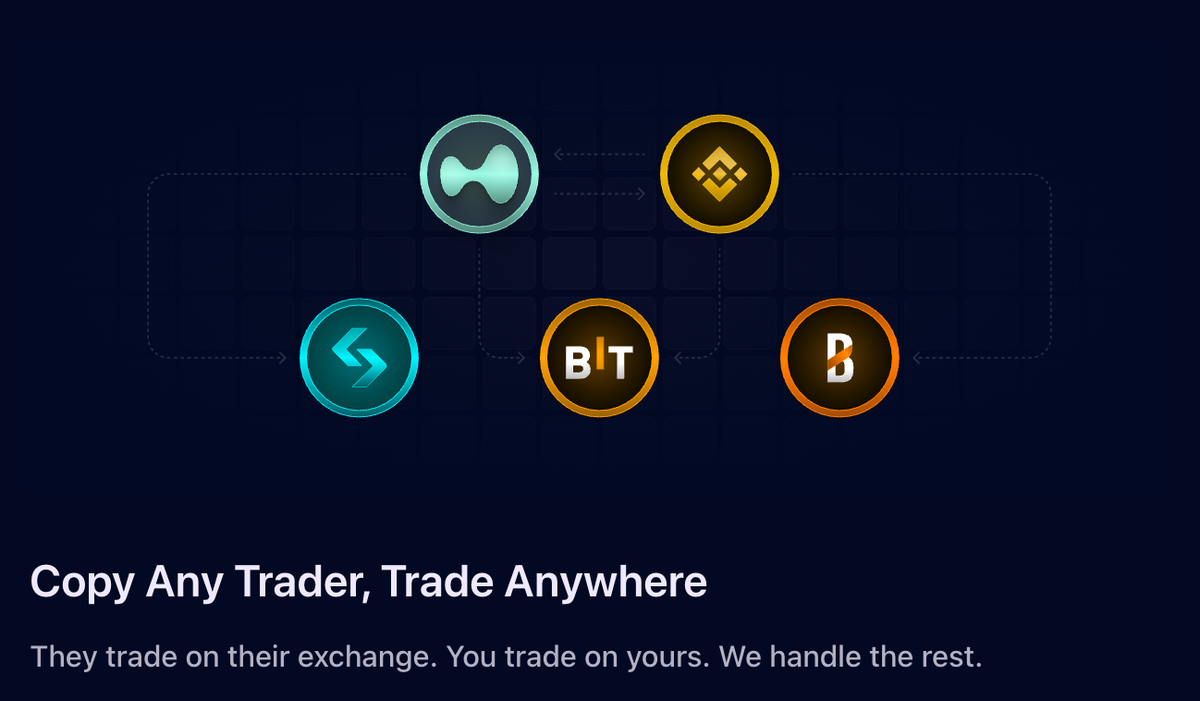
This guide walks through how traders are curated, what exchanges are supported and how they compare, the key features that give you control over your positions, and the full process to go from sign-up to your first copied trade.
How Mirrorly Curates Its Trader Leaderboard#
Most copy trading platforms let anyone become a "leader". All it takes is a connected account. The result is a leaderboard full of noise: accounts that got lucky once, high-risk gamblers on a hot streak, and traders with no meaningful track record.
Mirrorly takes a different approach. Every trader on the platform is handpicked and monitored. The leaderboard includes 240+ curated traders sourced from three pools: Binance Futures Smart Money, Hyperliquid, and Mirrorly's own exclusive traders. It's a living list. Underperformers get reviewed and removed. New traders are added as they prove consistency. The bar is a smaller set of vetted traders you can trust, not a dump of every account that ever turned a profit.
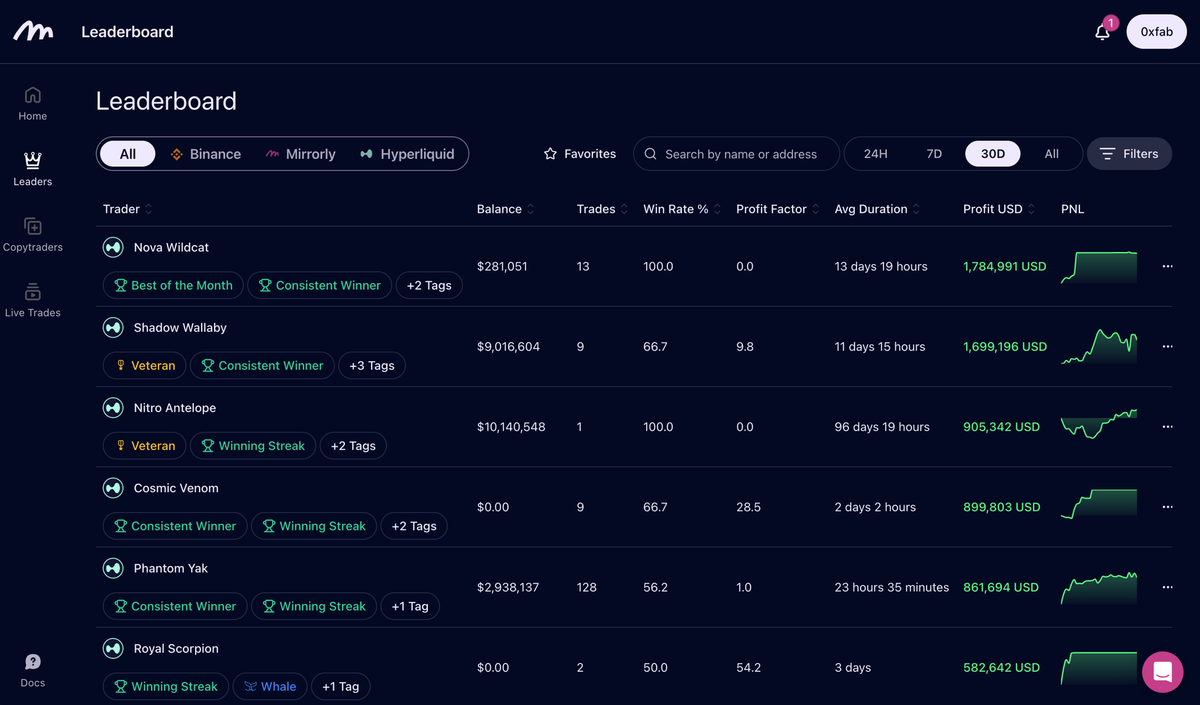
Each trader on Mirrorly's leaderboard is tagged to help you assess their profile at a glance. The Mirrorly team assigns tags like Veteran, Consistent Winner, Best of the Month, Winning Streak, Whale, and 7-Figure Club based on track record and behavior, not self-reported claims. Other tags flag useful context: Rising Star for newer traders with strong early results, AI Model for algorithmic strategies, Heavy Drawdown Risk for traders with large historical drawdowns, and Dormant for those not active.
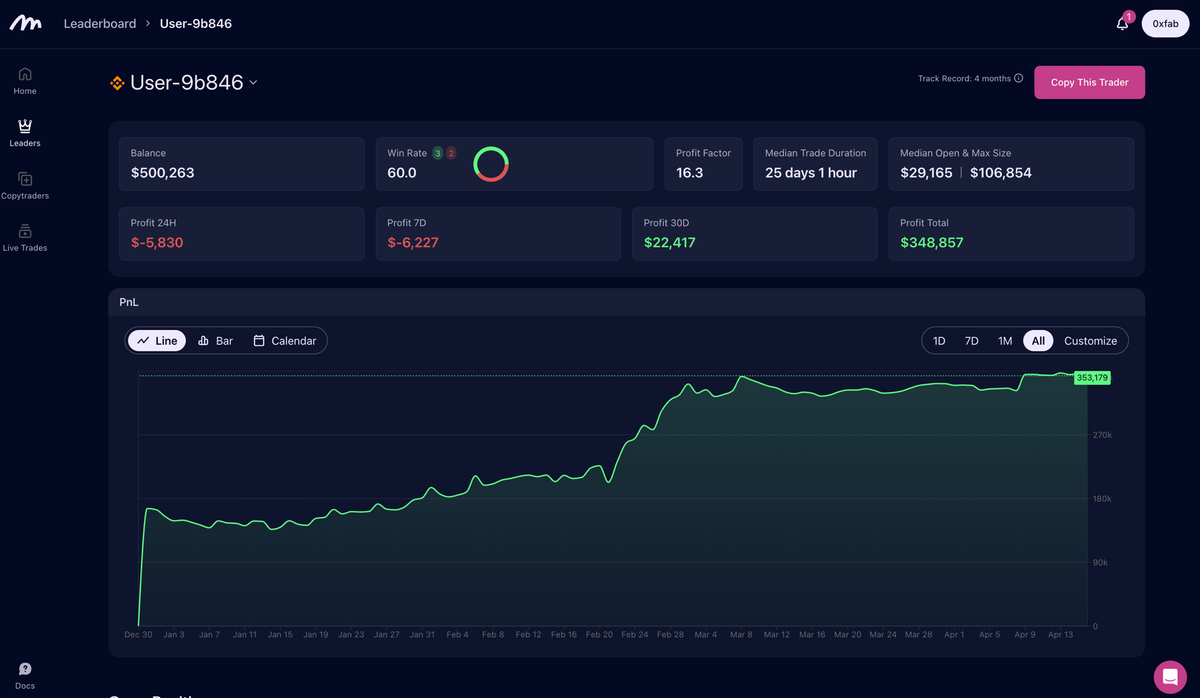
For every trader, Mirrorly tracks and displays key performance metrics: balance, win rate, profit factor, median trade duration, median open and max position size, and profit across multiple time windows (24H, 7D, 30D, and total). Click into any trader's profile to see their full PnL chart, open positions, and closed position history.
Binance Smart Money Traders#
One of Mirrorly's trader sources is Binance Futures Smart Money, Binance's platform for discovering top-performing futures traders. Binance Smart Money surfaces traders ranked by metrics like total ROI, PnL, and assets under management, and allows users to subscribe to follow their activity.

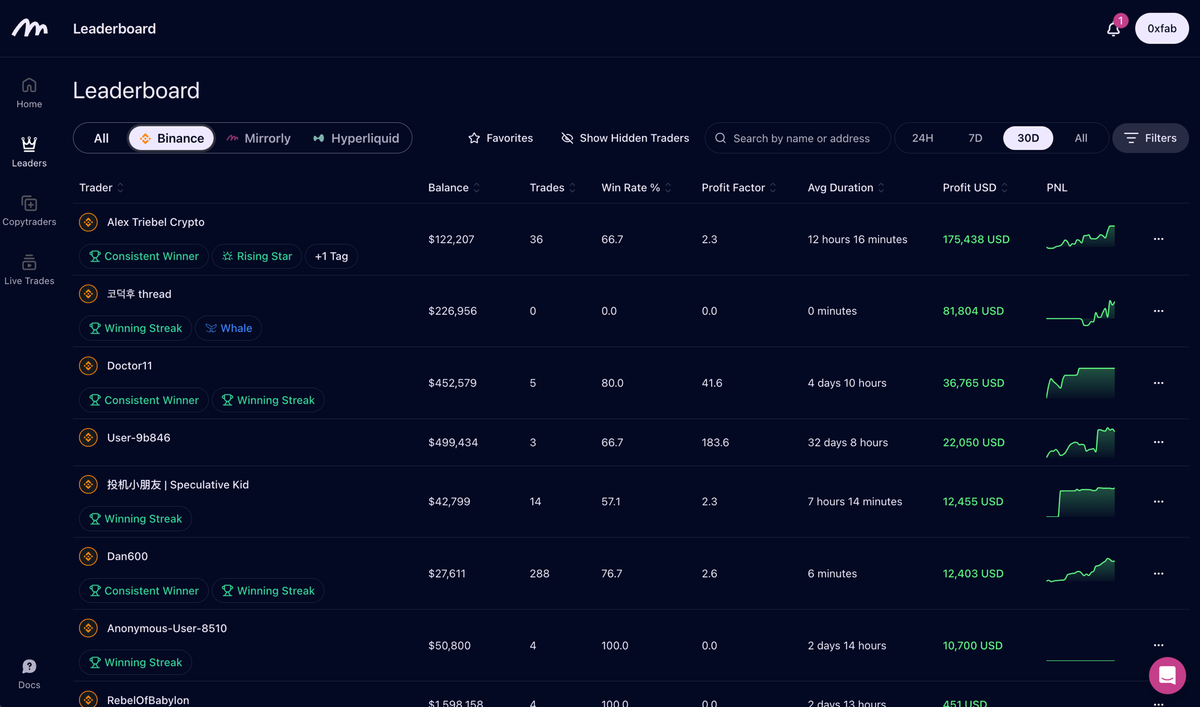
Mirrorly monitors traders on Binance Smart Money, tracking their positions, PnL, and performance metrics over time. From this pool, the Mirrorly team selects the traders that meet their curation criteria and adds them to the Mirrorly leaderboard. On Mirrorly, a Binance icon next to the trader's name marks Binance-sourced traders, and you can filter the leaderboard to show only Binance traders using the tab selector.
Because Mirrorly executes trades on your own exchange (Bybit, Bitget, BloFin, or Hyperliquid), you don't need a Binance account to copy Binance Smart Money traders. Mirrorly detects their positions and mirrors them to your connected exchange.
Hyperliquid Traders#
The second trader source is Hyperliquid, a fully on-chain perpetual futures decentralized exchange (DEX). Unlike centralized exchanges (CEXes) where trading data can be opaque, every position, trade, and PnL on Hyperliquid is publicly verifiable on-chain. Few sources of trader performance data offer this level of transparency.
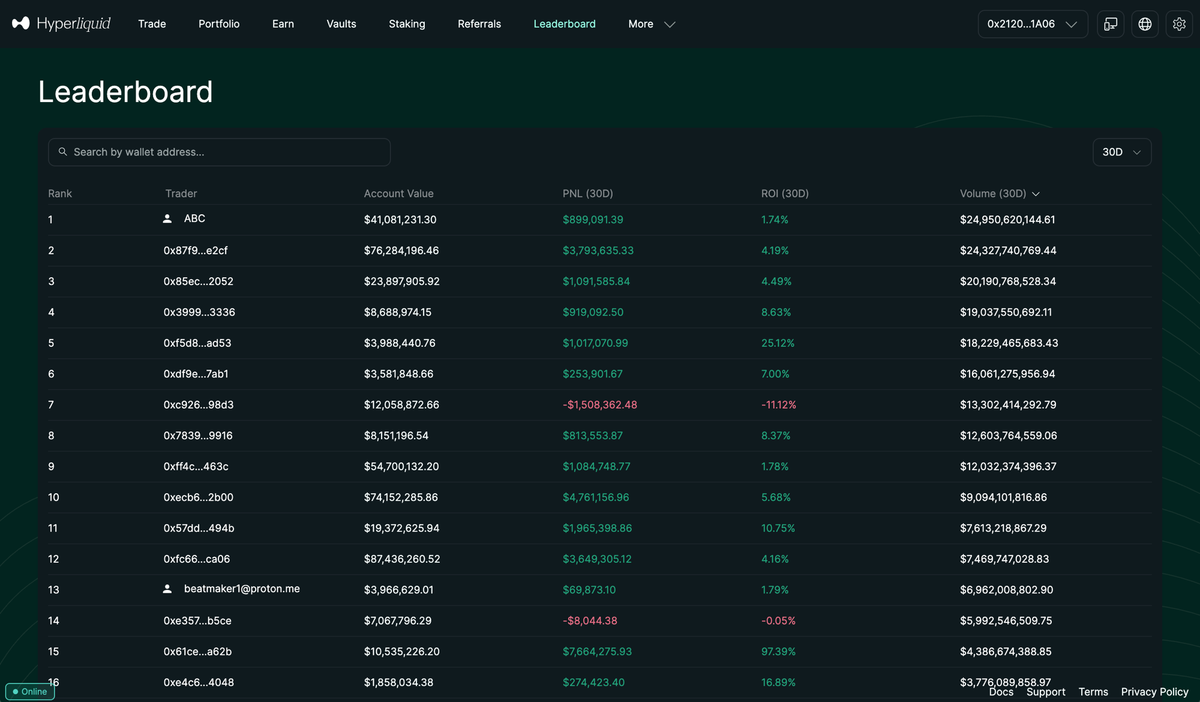
Mirrorly analyzes Hyperliquid's on-chain data to identify top-performing wallets, then adds the best ones to the leaderboard after vetting. On the Mirrorly leaderboard, Hyperliquid traders are marked with the Hyperliquid icon, and you can filter to show only them.
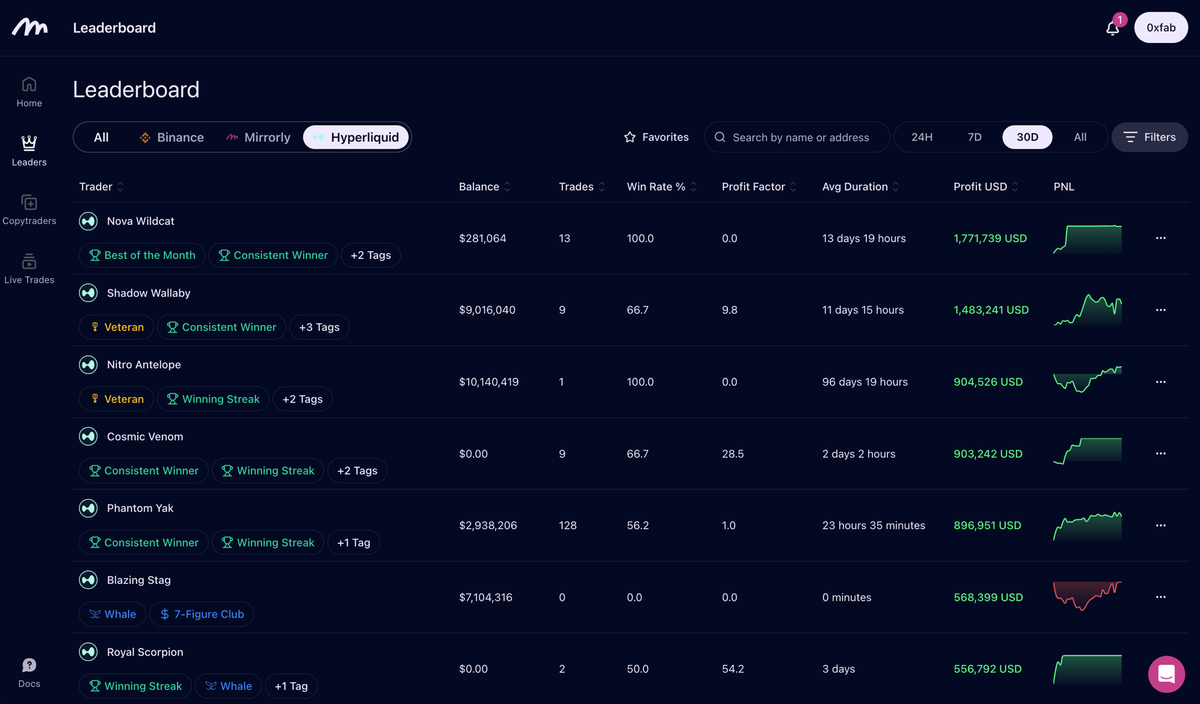
You can filter the leaderboard by source, including a dedicated "Mirrorly" tab for exclusive traders.
Hyperliquid is unique among Mirrorly's trader sources because it's also a supported execution exchange. You can discover traders from Hyperliquid and copy them on Hyperliquid, or on any other supported exchange. If you value full on-chain transparency for both the traders you follow and the trades you execute, Hyperliquid offers that end to end.
Where You Can Copy Trade#
The exchange where a trader is discovered doesn't have to be the exchange where you execute. You can find a top trader on Binance Smart Money and copy their trades on Bybit, or spot a Hyperliquid wallet and mirror it on BloFin. The trader source and the execution exchange are decoupled.
Mirrorly supports four execution exchanges. You connect via API key (or wallet, in Hyperliquid's case), and Mirrorly handles the rest: detecting the trader's positions and executing the corresponding trades on your account in real time. Your funds stay on your exchange at all times.
Bybit#
Bybit is one of the largest CEX crypto derivatives exchanges and the most popular choice among Mirrorly users.
Connection: You create a dedicated subaccount on Bybit and generate an API key with trading permissions. The API key is entered into Mirrorly when you set up your copytrader. Mirrorly never has withdrawal access, only the ability to read positions and place trades.
Fees: Mirrorly is free on Bybit when you sign up through Mirrorly's referral link. You pay only Bybit's standard trading fees, the same as any other Bybit user. Mirrorly adds nothing on top.
KYC: Required. If you already have a Bybit account under a different referral, you can create a new account with Mirrorly's link and transfer your KYC identity. It takes about 2 minutes.
Bitget#
Bitget is another major CEX with a strong derivatives offering.
Connection: Same as Bybit. Create a subaccount, generate an API key with trading permissions, and enter it in Mirrorly.
Fees: Free on Mirrorly when you sign up through Mirrorly's referral link. Standard Bitget trading fees apply. No Mirrorly fees.
KYC: Required. If you already have a Bitget account without Mirrorly's referral, create a new account with a different email and complete KYC again.
BloFin#
BloFin is a derivatives-focused exchange that stands out for requiring no KYC verification.
Connection: Generate an API key on BloFin and enter it in Mirrorly. Same setup process as the other CEXes.
Fees: Free on Mirrorly when you sign up through Mirrorly's referral link. Standard BloFin trading fees apply. No Mirrorly fees.
KYC: Not required. BloFin is one of the fastest onboarding options. You can go from sign-up to your first copied trade in minutes.
Hyperliquid#
Hyperliquid is a fully on-chain perpetual futures DEX with no intermediary and no custody by a third party. All trading happens on-chain.
Connection: Connect the wallet you trade with on Hyperliquid and sign two transactions: one to authorize the builder fee, and one to grant Mirrorly broker access for trade execution. Mirrorly cannot withdraw your funds. Your account must have at least **$1,000 in perps balance** (not spot) to create or enable a copytrader.
Fees: Mirrorly charges a builder fee per trade, starting at 0.03% and scaling down with your 30-day trading volume:
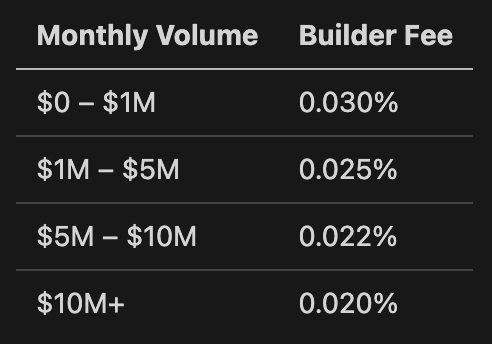
This builder fee is separate from Hyperliquid's standard trading fees. Because Hyperliquid is a DEX, there's no referral model like on CEXes. Instead, Hyperliquid provides a native mechanism called builder codes that allows applications like Mirrorly to charge a small fee per trade in exchange for their services. The fee is processed on-chain, and you approve a maximum builder fee when you first connect. You can revoke it at any time.
KYC: Not required. Hyperliquid is a DEX, so there's no identity verification. Combined with BloFin, these are the two options for users who want to start copy trading without KYC. You can also add Mirrorly's referral code during setup for a 4% discount on Hyperliquid trading fees.
Exchange Comparison#
The table below summarizes the key differences across all four supported exchanges at a glance.
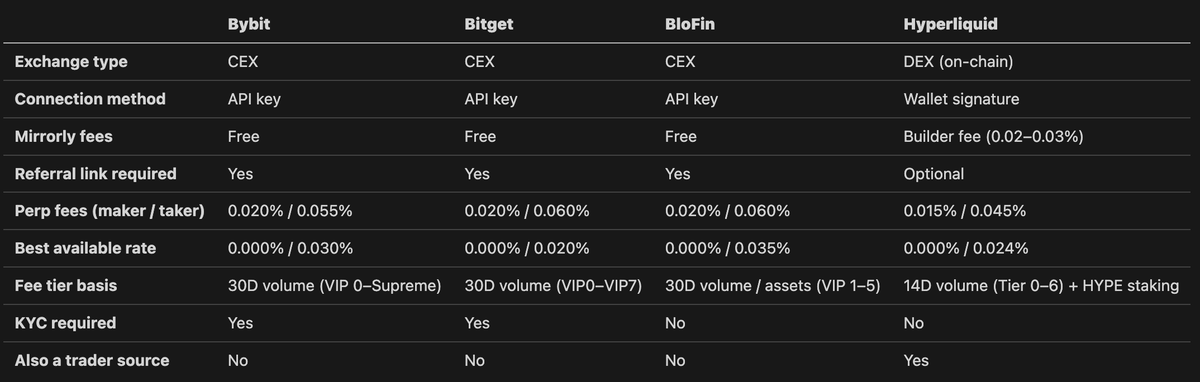
Perpetual futures fees shown are base-tier rates (first row) and best available rates (second row). Actual fees depend on your trading volume and VIP/tier level. Hyperliquid also offers up to 40% fee discount through HYPE staking and 4% via referral. Mirrorly uses cross margin on all exchanges. For full fee schedules, see Bybit, Bitget, BloFin, Hyperliquid.
Which exchange should you choose? It depends on what matters most to you:
- Lowest barrier to entry: BloFin or Hyperliquid. No KYC, fastest onboarding.
- Lowest total fees: Hyperliquid has the lowest base exchange fees, but adds the builder fee. On CEXes, Mirrorly is free, so Bybit, Bitget, or BloFin may be cheaper overall depending on your volume.
- Full transparency: Hyperliquid. Every trade is on-chain and publicly verifiable.
You can also run multiple copytraders on different exchanges at once. There's no limit to how many exchange connections you can set up on Mirrorly.
Key Features#
Mirrorly goes well beyond basic trade mirroring. Once you've connected an exchange and selected traders to follow, you have granular control over how trades are sized, how risk is managed, and how you monitor activity across the platform.
Automated Copy Trading#
When a trader you follow opens, increases, decreases, or closes a position, Mirrorly detects the change and executes the corresponding trade on your exchange. Execution is near-instant, sub-second in most cases.
You control how your trades are sized through two modes:
- Ratio to Trader: Your position size is a percentage of the trader's. If the trader opens a $10,000 position and your ratio is set to 10%, you open a $1,000 position.
- Fixed Value: Every new trade opens at a fixed USD amount you define, regardless of the trader's size.
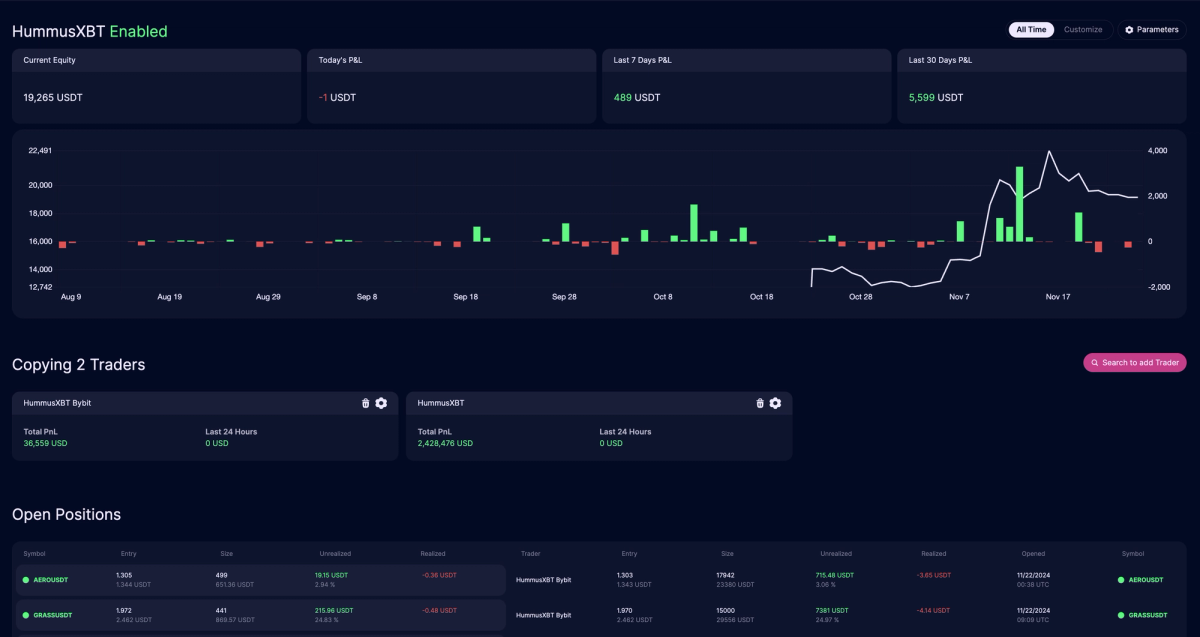
A single copytrader can follow multiple traders, including traders from both Binance Smart Money and Hyperliquid in the same copytrader. Each trader's positions are tracked on their own, and you can view your positions side by side with the trader's to compare entry prices, sizing, and PnL.
Trade Log#
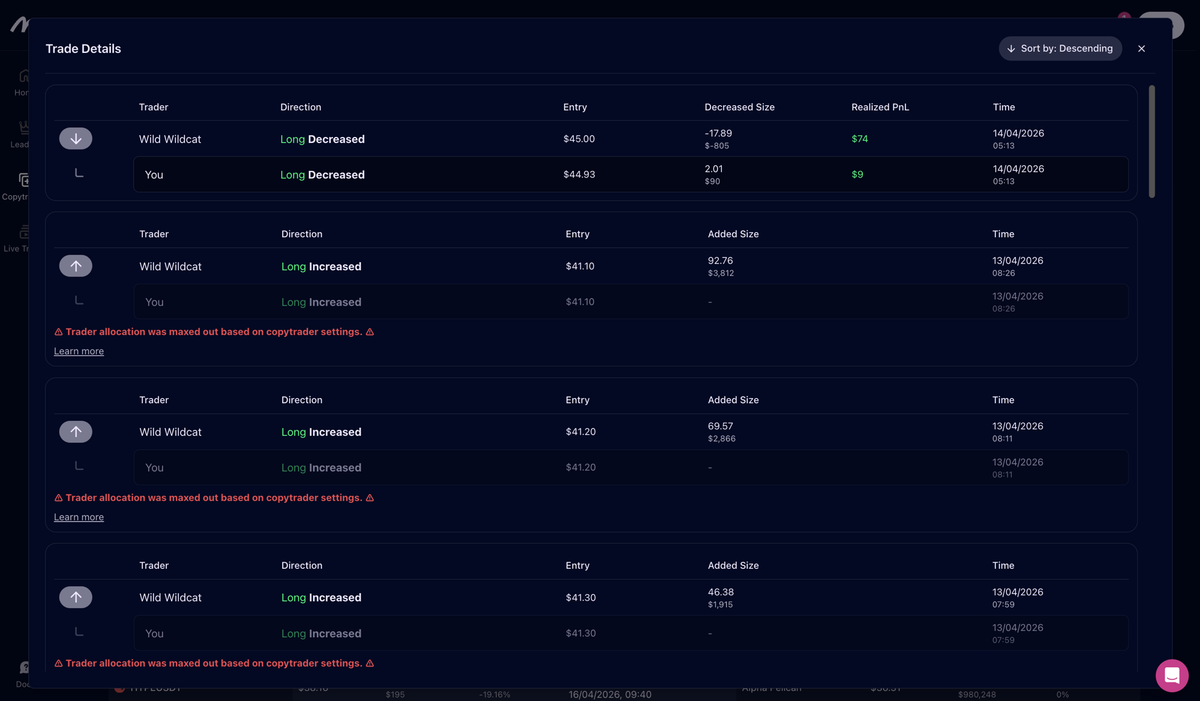
Every trade action in your copytrader is logged in detail. The Trade Details view shows a chronological record of each open, close, increase, and decrease for both the trader and your mirrored position side by side. You can see the trader's entry price and size next to yours, compare realized PnL, and spot cases where your settings capped a trade (e.g., "Trader allocation was maxed out based on copytrader settings"). Use this to review execution quality and tune your parameters over time.
Risk Controls#
Mirrorly provides several parameters to cap your exposure and protect your capital:
- Limit Account Size (USD): Sets a maximum total notional value for your copytrader. Once reached, no new positions are opened.
- Maximum Position Size (USD): Caps the size of any single position per trader.
- Maximum Symbol Size (USD): Caps your total exposure to a specific symbol across all traders in the copytrader.
- Slippage %: Controls the maximum price difference you'll accept between the trader's execution and yours. If price has moved beyond your threshold, the trade is skipped.
- Basic Stop Loss %: A per-position stop loss that triggers on its own.
- Take Profit Orders: Set your own take-profit logic using basic or advanced profit targets.
- Maximum Number of Increases: Limits how many times a position can be increased.
- Maximum Increase Size %: Caps the size of each increase.
Trader-Specific Parameters#
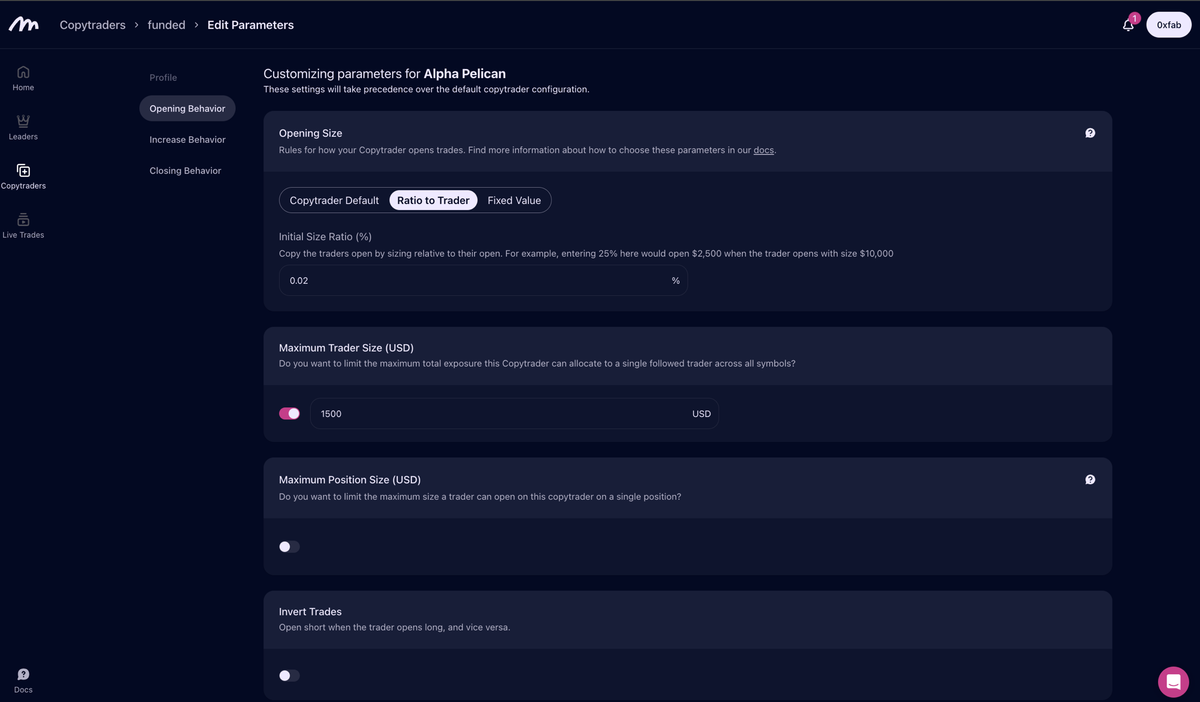
You don't have to apply the same settings to every trader in a copytrader. Mirrorly lets you override parameters on a per-trader basis. Click the settings icon next to any trader's name to customize their ratio, maximum position size, maximum trader size, and other settings, all within the same copytrader.
This matters when following traders with very different styles. A high-frequency scalper and a swing trader with large positions can coexist in the same copytrader, each with sizing and risk settings tuned to their behavior.
Join Trade#
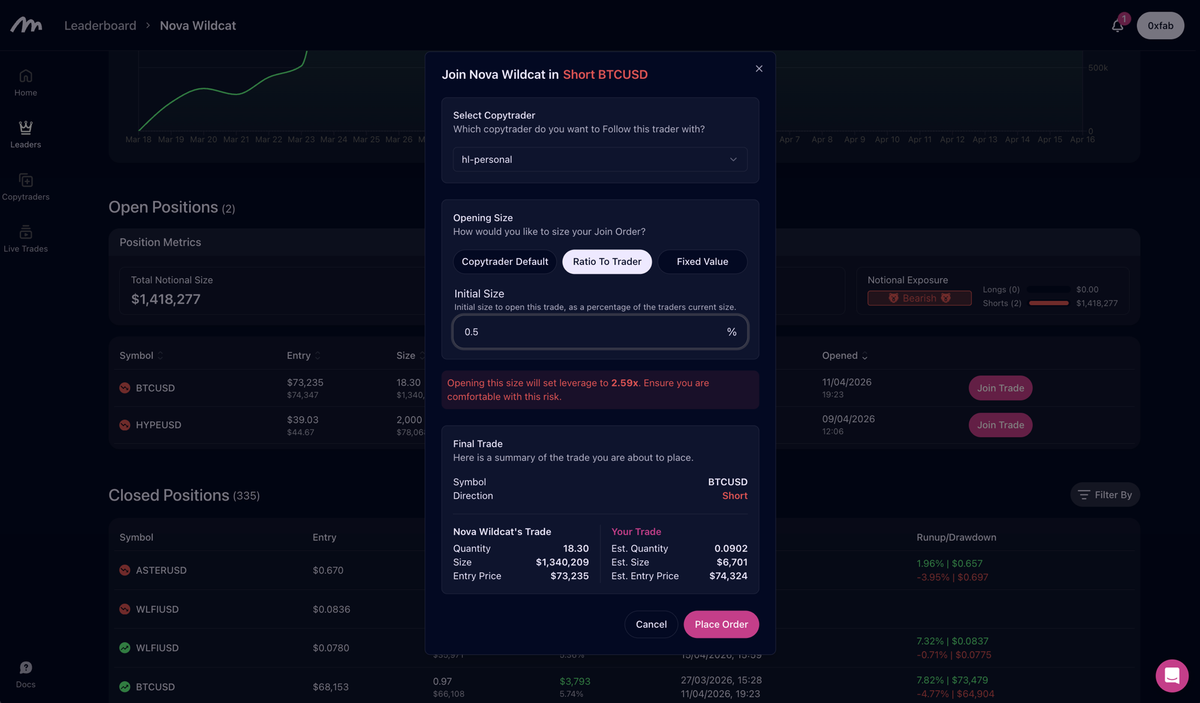
If a trader you follow (or any trader on the leaderboard) already has an open position that you want to enter, Join Trade lets you jump in mid-trade. When you join, Mirrorly copies all subsequent increases, decreases, and closures for that position. Your entry will be at the current market price, which may differ from the trader's original entry.
The Join Trade button appears next to any open position you're not in. When you click it, you choose which copytrader to use and set your sizing (copytrader default, ratio to trader, or fixed value). The modal shows a full summary of the trade before you confirm, including the trader's entry vs. your estimated entry and the resulting leverage.
Inverse Copy Trading#
For traders whose positions you want to take the opposite side of, Mirrorly offers inverse copy trading. When enabled, if the trader opens a long, your account opens a short, and vice versa. This is configured per trader within Trader-Specific Parameters by toggling "Invert Trades".
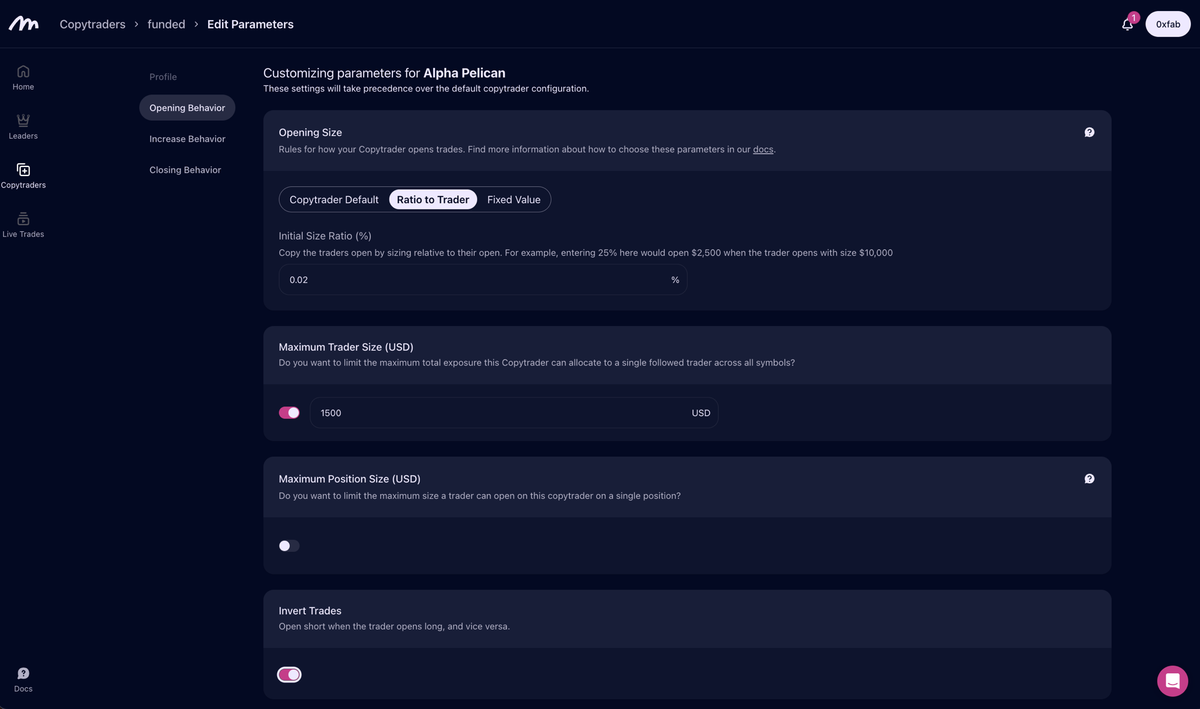
Inverse copying is a higher-risk strategy that bets against the trader's direction. It can make sense in specific contexts, for example if a trader keeps losing on a particular market or has a track record you want to fade. Use with caution.
Live Trades Feed#
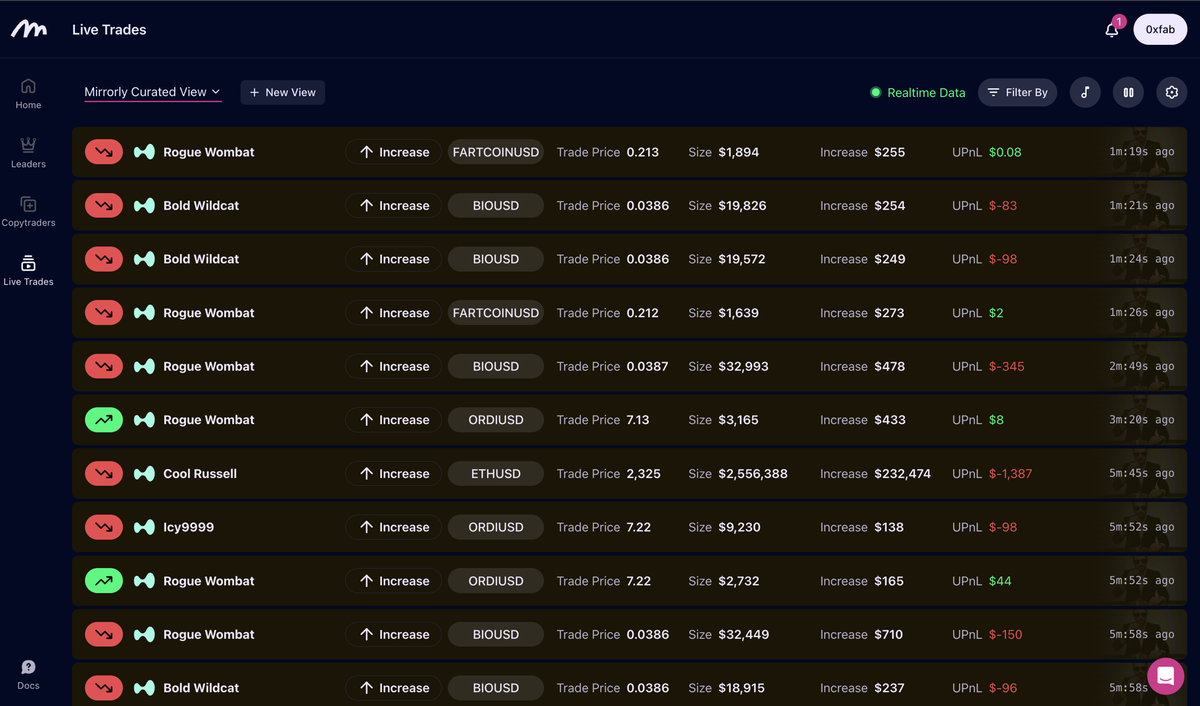
The Live Trades Feed streams every trade action across the Mirrorly platform in real time: opens, closes, increases, and decreases from all 240+ traders. It updates as trades happen, showing you the trader, action type, symbol, trade price, position size, and unrealized PnL for each event.
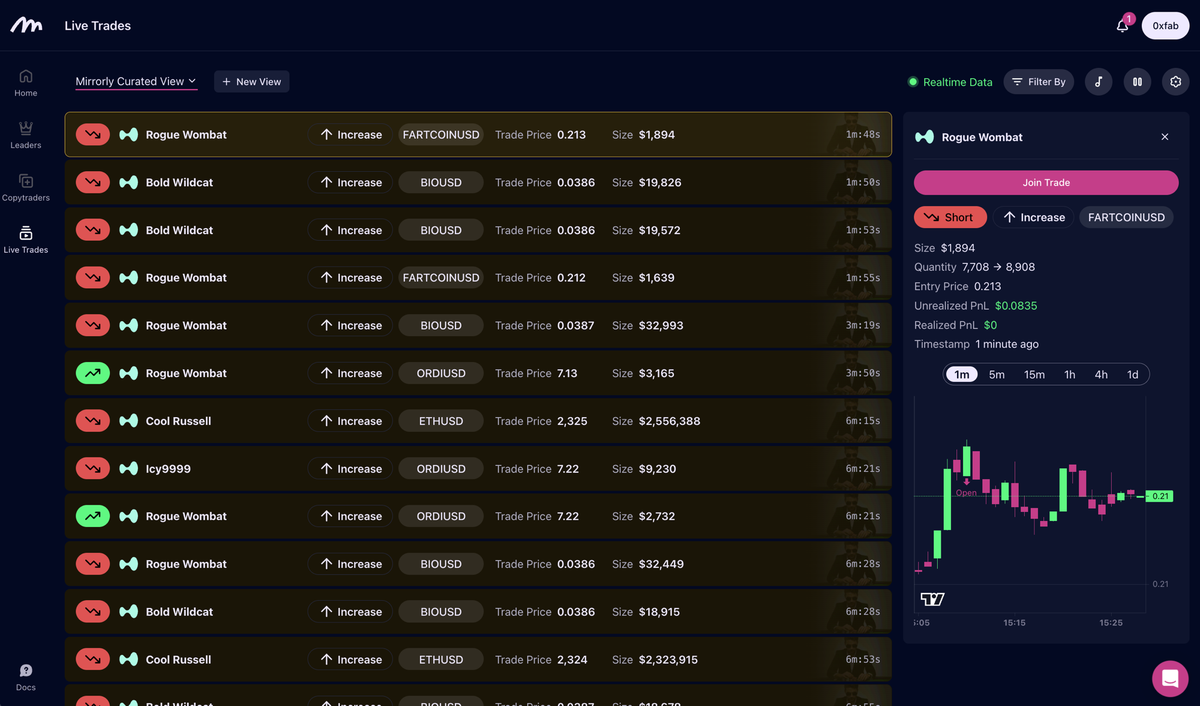
You can click on any trade in the feed to open a detail panel showing the full position breakdown: size, quantity, entry price, unrealized and realized PnL, and a live price chart.
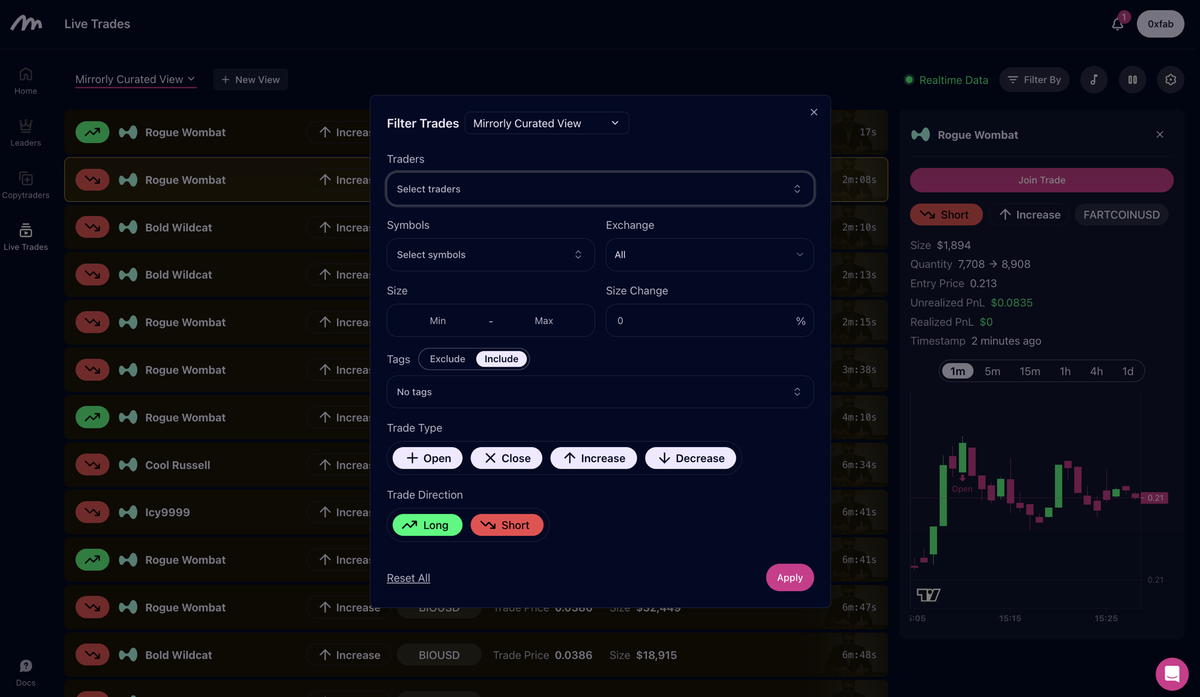
You can filter the feed by specific traders, symbols, exchanges, trade size, trade type (open, close, increase, decrease), trade direction (long or short), and tags. Save your filters as custom views for quick access, for example a view that shows only large opens from your favorite traders.
The Live Trades Feed is one of the fastest ways to discover new traders worth following. Watching how traders behave in real time, what they trade, how they size, how they react to market moves, gives you context that stats alone can't provide.
Stay in the Loop#
You don’t need to sit in front of your computer to monitor your copytraders.
Mirrorly integrates with Telegram so you can receive trade notifications, track open positions, and stay updated when traders you follow open, increase, decrease, or close positions.
Telegram notifications are useful for day-to-day monitoring: you can see what your copytraders are doing, check when new positions open, and keep an eye on PnL without logging into the platform every time.
Mirrorly also runs live feeds for the broader curated trader list. The @MirrorlyLive X account and MirrorlyLive Telegram channel act as a live highlight reel for notable moves from Mirrorly’s curated traders. Big opens, large closes, interesting increases, and other high-signal activity are posted as they happen.
This gives you two ways to stay informed:
- Personal notifications: updates about your own copytraders and positions.
- Market-wide trader activity: live highlights from the curated Mirrorly leaderboard through @MirrorlyLive and the Telegram feed.
Use both together: Telegram alerts help you monitor your own account, while MirrorlyLive helps you discover traders, spot active markets, and see what the best traders are doing in real time.
Track Record & Social Proof#
Mirrorly has been operating since 2023 and publishes its performance data in public. As of early 2026, the platform reports $10.5M in lifetime user profit and $8.6B in total volume traded across all supported exchanges.
2025 Year in Review#
Mirrorly published a detailed Year in Review covering the full 2025 performance. Across 425+ tracked traders, the platform recorded over 725k closed positions, $239 billion in trading volume, and $73 million in aggregated realized PnL from its trader universe. 60% of all tracked traders finished 2025 profitable, with a median PnL of $48k. Profitability on the leaderboard was not confined to a small elite.
On the user side, Mirrorly's founder Arti (@artikokus) published a transparency report confirming +$4.92M in aggregated copy trading PnL across all Mirrorly users for the year, the second profitable year in a row. 51% of all copytraders ended the year profitable, in a year where BTC closed negative and most altcoins were down badly.
To put that in context: over the same period, only 0.42% of Pump.fun wallets (roughly 55k out of 13.4 million) made at least $10k, and only low double-digit percentages of Hyperliquid traders were profitable. Compare those numbers to 51% profitability on Mirrorly. Copying curated, proven traders changes the distribution.
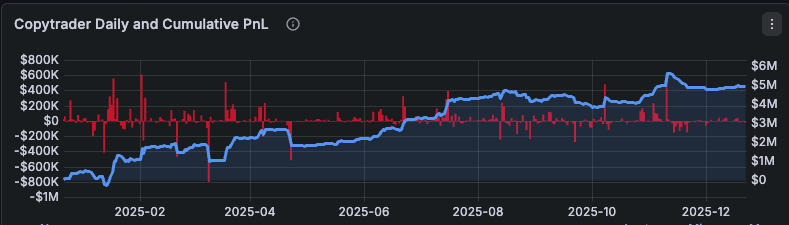
As Arti put it: "Copy trading might not be cool. It will not get you clout or followers. But the data shows that this is a serious alpha tool that can make you real money."
Personal Experience: 9+ Months Using Mirrorly#
@0xfab_eth published a thread on X documenting his results using Mirrorly over 9+ months of active copy trading. The thread covers his full setup: running multiple copytraders across different accounts, using ratio-based sizing, setting maximum account exposure at 1.0-1.5x balance, and diversifying across traders with different styles so no single person's drawdown wrecks the portfolio.
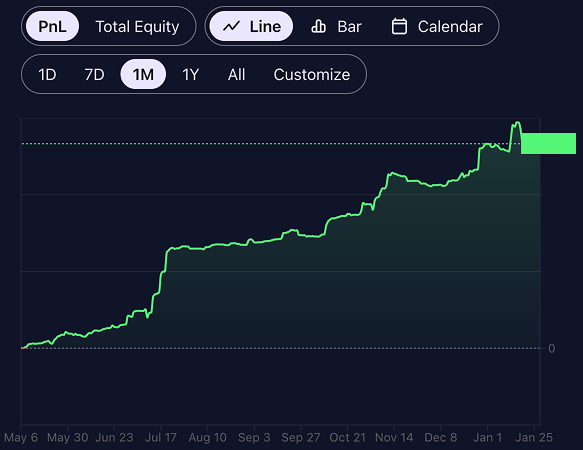
Key takeaway from the thread: "The actual work is minimal: check in on your portfolio, make small tweaks over time, use common sense, and most importantly do not over risk. The hard part of trading, the part that requires skill and time, that's what you're outsourcing."
Monthly & Quarterly Top Trader Reports#
Mirrorly publishes regular deep-dive reports analyzing the top traders on the leaderboard by realized PnL. Monthly reports cover the top 3 traders each month, breaking down their strategy, risk metrics, win rate, profit factor, position sizing, and individual trades. Quarterly reports zoom out to the top 10 and analyze broader trends across market conditions.
These reports are published on the Mirrorly Knowledge Base. They serve two purposes: transparency about the quality of traders on the platform, and practical insight into how different trading styles perform. Both are useful context before you decide who to copy.
Affiliate Program#
Mirrorly has a multi-level affiliate program that lets you earn a share of the revenue generated by users you refer. It's free to join, with no posting requirements, no content calendars, and no mandatory promotion. You share your link when it makes sense for you.
You earn a percentage of the revenue generated by your referrals. This includes exchange-related revenues attributed to Mirrorly, and will also include subscription payments once subscriptions launch. The program has three commission tiers:
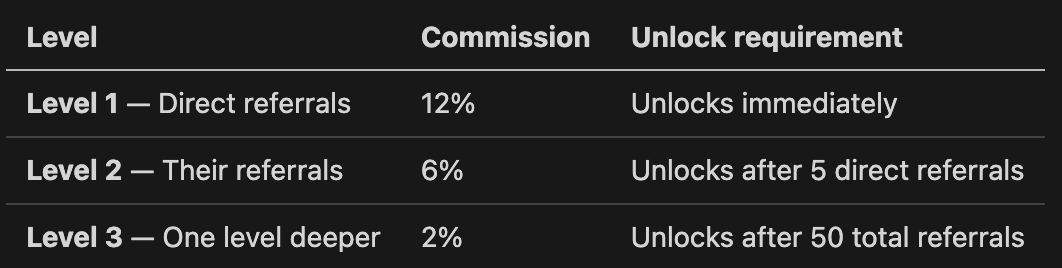
Levels unlock without manual action. You can also offer your referred users a rebate of up to 5% as a signup incentive. The rebate comes from your Level 1 commission, is withdrawable by users, and is controlled by you.
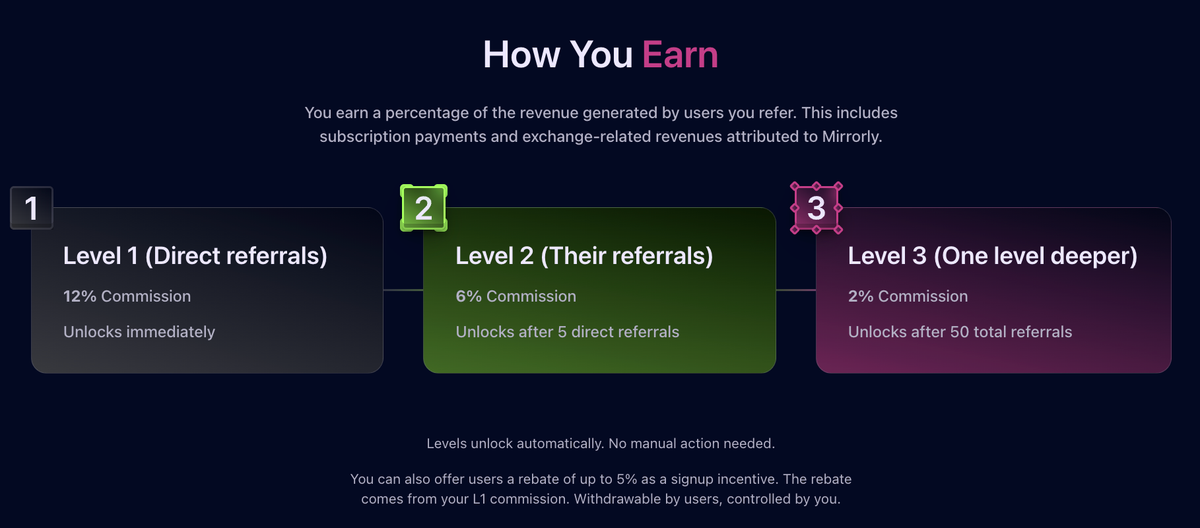
Your referral link works across all exchanges. Whether the user you refer chooses Bybit, Bitget, BloFin, or Hyperliquid, the referral sticks. One link covers everything.
The program is a good fit for Mirrorly users, crypto content creators, YouTube channels, trading educators, DeFi bloggers, and community leaders. You can join the affiliate program here.
How to Get Started#
Getting from sign-up to your first copied trade takes a few minutes.
1. Create a Mirrorly account#
Go to mirrorly.xyz and sign up. You can authenticate with a Web3 wallet (MetaMask, Rabby, or any WalletConnect-compatible wallet) or with a traditional email/Google account. No funds need to be deposited. Your Mirrorly account is just your access to the platform.
2. Sign up on a supported exchange#
If you don't already have an account on one of the supported exchanges, create one using Mirrorly's referral link to get free access:
- Bybit — KYC required
- Bitget — KYC required
- BloFin — no KYC
- Hyperliquid — no KYC, referral optional
If you already have an account on one of these exchanges but signed up without Mirrorly's referral, see the Getting Started guide for options. On Bybit, for example, you can transfer your KYC to a new account in about 2 minutes.
3. Create a subaccount and generate API keys#
Create a dedicated subaccount on your exchange for Mirrorly. Don't run Mirrorly on the same account where you trade manually, as it can cause conflicts and increase liquidation risk.
Generate an API key on your subaccount with trading permissions and enter it in Mirrorly. Step-by-step guides for each exchange:
4. Create your first copytrader#
In Mirrorly, navigate to the Copytraders tab and click "Create New". Name your copytrader, select your exchange, and enter your API keys. Then configure your trading parameters. The two settings that matter most:
Ratio to Trader (position sizing): This is the most important setting in copy trading. Your initial position size shapes your entire risk profile. Increases and decreases later on are applied proportionally, but the open is the defining moment. You're choosing how big you want to go relative to the trader's own position, so compare the trader's balance and typical position sizes with your own equity when selecting a ratio. Start conservative. You can always increase later once you've seen how the trader operates.
Limit Account Size (max exposure): This caps your total portfolio exposure across all positions in the copytrader. It's your safety net. Better to miss an opportunity than risk losing more than you're comfortable with. Mirrorly uses cross leverage, so your effective leverage depends on the ratio between your Limit Account Size and your actual balance. For example, if you have $10,000 in your account and set the limit to $20,000, you are leveraged 2x. A 50% drawdown would wipe out your entire account.
You'll also find settings for slippage tolerance, maximum position size, increase behavior, and closing behavior (stop loss and take profit). Stop loss and take profit are available but optional. Some users set them for extra protection when starting out. Others prefer to trust the traders they follow and let trades play out. There's no wrong approach, but if you're new, keeping a stop loss on while you build confidence is a reasonable starting point.
5. Browse the leaderboard and select traders to copy#
Go to the Leaders tab and explore the curated leaderboard. Every trader on the platform has a verified track record that Mirrorly has collected and validated. The team has been running its own screeners across Binance and Hyperliquid since the bear market. Filter by source, sort by profit, win rate, or profit factor, and use the time filters (24H, 7D, 30D, All) to evaluate performance across different periods.
Start by looking for traders tagged as Consistent Winner, or use any of the other tags to narrow down what matters to you. For example, exclude Heavy Drawdown Risk if you can't stomach big swings.
When you click into a trader's profile, look at:
- Total PnL & Track Record: Their actual profit/loss and how long they've been tracked on Mirrorly. Longer track records give you a better picture. A few weeks of data tells you less than a few months across different market conditions.
- Win Rate + Profit Factor: How often they win and how much they make relative to what they lose. A profit factor above 1.5 is solid, above 2.0 is strong.
- Drawdown: How much they've lost at their worst. If you can't stomach a 20% drawdown, don't copy a trader who has one.
- Trade Frequency & Duration: Some traders make several trades a day, others trade a few times a week. Match this to your comfort level and how often you want to check in.
For a more detailed guide, see Choosing a Trader to Copy.
When you've found traders you want to follow, go back to your copytrader and click "Add Trader" to add them. Start with one or two traders. You can always add more as you get comfortable.
6. Enable and start copying#
Once your traders are added, click "Enable Trader" under Status for each one. Your copytrader is now live. The next time a followed trader opens a position, Mirrorly executes the corresponding trade on your exchange.
7. Monitor your positions#
Keep an eye on your copytrader from the Copytraders tab, where you can see your open positions side by side with the trader's. Use the Live Trades Feed to watch activity in real time. Connect Mirrorly to Telegram to get trade notifications on the go.
Start copy trading for free at mirrorly.xyz
FAQ#
Getting Started#
What is Mirrorly?
Mirrorly is a free, non-custodial copy trading platform for crypto perpetual futures. It curates a leaderboard of 240+ top traders from Binance Smart Money and Hyperliquid, and lets you mirror their trades on Bybit, Bitget, BloFin, or Hyperliquid. Your funds stay on your exchange at all times.
Is Mirrorly free?
Yes. On Bybit, Bitget, and BloFin, Mirrorly is free when you sign up through Mirrorly's referral link. On Hyperliquid, a small builder fee starting at 0.03% applies per trade. There are no subscriptions, no performance fees, and no hidden charges on any exchange.
What exchanges does Mirrorly support?
Mirrorly supports four execution exchanges: Bybit, Bitget, BloFin, and Hyperliquid. You can run copytraders on multiple exchanges at the same time.
Do I need to deposit funds on Mirrorly?
No. You never deposit funds on Mirrorly. Your capital stays on your own exchange account. Mirrorly connects via API key (or wallet signature on Hyperliquid) and only has permission to read positions and place trades, never to withdraw.
Does Mirrorly have access to my funds?
No. Mirrorly is non-custodial. It connects to your exchange through API keys with trading permissions only. Mirrorly cannot withdraw, transfer, or access your funds in any way.
What's the minimum capital to start copy trading?
There is no minimum set by Mirrorly. The practical minimum depends on the exchange you use and the traders you follow. On Bybit, Bitget, and BloFin, most perpetual futures positions can be opened with just a few dollars. On Hyperliquid, the minimum account balance is $1,000. A reasonable starting balance for copy trading on CEXes is a few hundred dollars, enough to follow at least one trader with appropriate position sizing.
How long does it take to set up?
Most users can go from sign-up to their first live copytrader in under 10 minutes. The longest part is creating an exchange account and completing KYC (if required). On BloFin and Hyperliquid, where no KYC is needed, setup can take as little as a few minutes.
How It Works#
Can I copy Binance Smart Money traders on Bybit?
Yes. The exchange where a trader is discovered (Binance Smart Money, Hyperliquid) is independent from the exchange where you execute trades. You can copy any trader on any supported exchange.
Can I copy Hyperliquid traders on Bitget?
Yes. Same principle. Mirrorly detects the trader's positions on their source exchange and mirrors them on your connected exchange, regardless of which one it is.
How does Mirrorly choose which traders to feature?
Every trader on the leaderboard is handpicked by the Mirrorly team. Traders are sourced from Binance Smart Money and Hyperliquid, evaluated on performance metrics, and monitored on an ongoing basis. Underperformers are reviewed and removed. The leaderboard is a curated, living list, not a static dump of every profitable account.
How often is the leaderboard updated?
The leaderboard is maintained on an ongoing basis. New traders are added as they prove consistency, and underperformers are reviewed and removed. Performance metrics (profit, win rate, profit factor, etc.) update in real time.
What happens if a trader I'm copying starts losing?
Your copytrader will mirror their losing trades just as it mirrors their winning ones. This is why risk controls matter. Use stop-loss settings, position size caps, and account size limits to protect your capital. You can also disable or remove a trader from your copytrader at any time.
What is Join Trade?
Join Trade lets you enter a trader's existing open position mid-trade. When you join, Mirrorly copies all subsequent increases, decreases, and closures for that position. Your entry will be at the current market price, which may differ from the trader's original entry.
Can I copy trade short sellers?
Yes. Mirrorly copies both long and short positions. When a trader opens a short, your account opens a short. You can also filter the Live Trades Feed by trade direction (long or short) to find traders who short often.
Can I copy multiple traders at the same time?
Yes. A single copytrader can follow multiple traders, including traders from both Binance Smart Money and Hyperliquid. You can also run multiple copytraders across different exchanges.
Safety & Risk#
Is copy trading safe?
Copy trading carries the same risks as any leveraged futures trading. You can lose part or all of your capital. The difference is that your trades follow a trader with a proven track record rather than your own decisions. Use Mirrorly's risk controls (stop-loss, position size limits, account size limits) to manage your exposure, start with a small allocation, and never risk more than you can afford to lose.
What risk controls does Mirrorly offer?
Mirrorly provides several risk management tools: basic stop-loss per position, take-profit orders, maximum position size per trader, maximum symbol size across all traders, limit account size (total exposure cap), slippage tolerance, maximum number of increases, and maximum increase size. These can be set at the copytrader level or overridden per trader.
Can I set a stop loss?
Yes. Mirrorly supports a basic stop-loss percentage that applies per position. You configure it in the Closing Behavior section of your copytrader settings.
What if an exchange goes down during a trade?
If your exchange experiences downtime, Mirrorly cannot execute trades until the exchange is back online. Positions that were already open remain on the exchange. Once connectivity is restored, Mirrorly resumes normal operation. This is a risk inherent to any exchange-dependent trading system.
Performance#
How profitable is copy trading on Mirrorly?
Past performance varies by trader and market conditions. In 2025, Mirrorly's aggregated user PnL was +$4.92M, with 51% of all copytraders ending the year profitable in a year where BTC closed negative. In Q1 2026, with BTC down 25%, about 55% of tracked traders still finished the quarter profitable. Individual results depend on which traders you follow, how you size positions, and how you manage risk.
Affiliate#
Does Mirrorly have an affiliate program?
Yes. Mirrorly's affiliate program is free to join and offers up to 20% commission across three levels: 12% on direct referrals (unlocks immediately), 6% on their referrals (unlocks after 5 direct referrals), and 2% one level deeper (unlocks after 50 total referrals). Join here.
How do I earn as a Mirrorly affiliate?
You earn a percentage of the revenue generated by users you refer, including exchange-related revenues attributed to Mirrorly and subscription payments once subscriptions launch. Your referral link works across all exchanges. You can also offer referred users a rebate of up to 5% as a signup incentive.
Who is the affiliate program for?
The program is open to anyone. It's a good fit for Mirrorly users, crypto content creators, YouTube channels, trading educators, DeFi bloggers, and community leaders. There are no posting requirements or content obligations.
Want to Learn More?#
If you have more questions, check the Mirrorly Knowledge Center and Support Center for setup guides, exchange-specific instructions, trader selection tips, and troubleshooting help.
You can also join the Mirrorly community on Telegram and Discord to ask questions, follow product updates, and see how other users are setting up their copytraders.
Start copy trading for free at mirrorly.xyz.