Order book imbalances sit at the core of how arbitrage forms in crypto markets. While price charts show what already happened, the order book reveals what is about to happen. For traders who care about execution, liquidity, and short lived inefficiencies, understanding these imbalances is far more valuable than watching candles alone.
In crypto, arbitrage is rarely created by “wrong prices.” It is created by uneven liquidity reacting at different speeds across markets.
Understanding Order Book Imbalances in Practice#
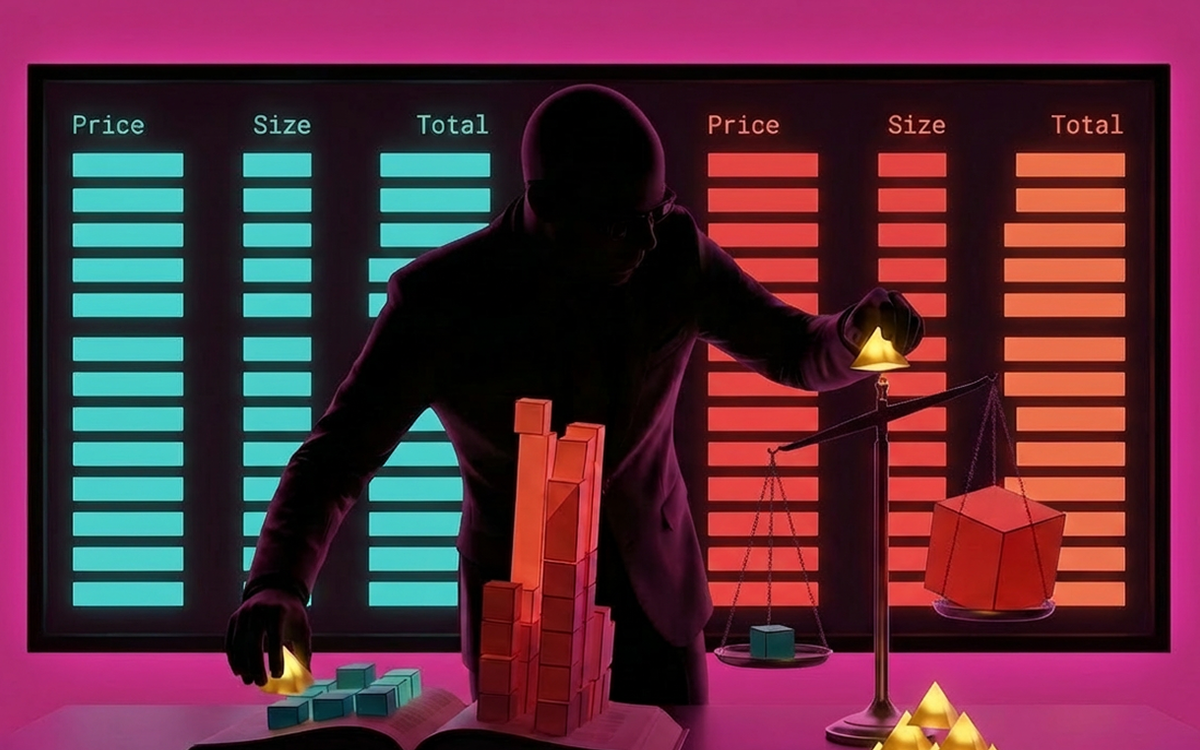
An order book imbalance occurs when buying pressure and selling pressure near the current price are not evenly distributed. This can happen when one side of the book becomes thin, when large orders absorb liquidity, or when participants aggressively remove resting orders.
For example, if sell side liquidity suddenly disappears above the current price, even small market buys can push price sharply higher. At the same time, related trading pairs may still reflect older liquidity conditions. That gap between updated and outdated pricing is where arbitrage begins.
Why Crypto Order Books Drift Out of Sync#
Crypto markets are uniquely vulnerable to these effects because liquidity is fragmented. Each trading pair maintains its own order book, reacts independently, and updates at different speeds.
A large market order in one pair can rapidly shift the best bid or ask, while a correlated pair adjusts more slowly due to deeper liquidity or lower trading activity. During that brief window, prices across pairs are mathematically inconsistent even though nothing is “wrong” with the market.
This asynchronous price adjustment is a defining feature of crypto microstructure.
From Imbalance to Arbitrage Opportunity#
Arbitrage opportunities form when one order book reflects new information faster than another. The imbalance itself is not the opportunity. The opportunity appears when execution prices across related markets no longer align.
Arbitrage traders attempt to lock in this divergence before liquidity normalizes.
The Role of Market Orders and Urgency#
Most meaningful imbalances are created by urgency. Market orders prioritize execution speed over price and immediately consume available liquidity.
These conditions are most common during periods of stress such as news releases, liquidation events, or sudden volatility spikes. When urgency dominates, liquidity becomes expensive, and price moves are uneven across markets.
For arbitrage traders, urgency is not noise. It is the catalyst.
Why Last Traded Price Hides Risk#
Many traders fail to understand arbitrage because they rely on last traded price. Last price only reflects completed transactions. It says nothing about how much liquidity remains or at what cost the next trade will execute.
Two markets can display identical prices while offering drastically different execution outcomes. One may support size with minimal slippage, while the other collapses under small pressure. True arbitrage only exists when executable prices diverge, not when charts look similar.
When Order Book Imbalances Do Not Convert to Profit#
Not all imbalances are tradable. Many disappear once fees, slippage, and latency are accounted for.
Common failure points include:
- Fees overwhelming small spreads
- Slippage erasing theoretical profit
- Latency causing missed execution
- Liquidity that vanishes when hit
This is why many arbitrage strategies appear profitable in backtests but fail in live trading.
Why Order Book Imbalances Matter Beyond Arbitrage#
Even traders who never execute arbitrage benefit from understanding order book behavior. Imbalances often explain sudden breakouts, failed moves, or sharp reversals that appear random on charts.
By reading order books, traders gain insight into where liquidity is fragile, where pressure is building, and where price is likely to react next. This knowledge improves execution across all strategies.
Order Books as the Foundation of Market Insight#
As crypto markets mature, simple price based edges fade. What remains is the ability to interpret structure, liquidity, and execution risk.
Order book imbalances reveal how prices actually move, how arbitrage is born, and why it disappears just as quickly. For traders seeking a deeper understanding of crypto markets, this perspective is not advanced. It is essential.